Semiconductor Notes

0 Likes

1 Views

Copied to clipboard
0 Likes
45 Views
Copied to clipboard
0 Likes
16 Views
Copied to clipboard
0 Likes
24 Views
Copied to clipboard
0 Likes
12 Views
Copied to clipboard
0 Likes
9 Views
Copied to clipboard
0 Likes
30 Views
Copied to clipboard
Semiconductor notes
oms-physicspractical
Physicspractical
0 Likes
18 Views
Copied to clipboard
1 Likes
169 Views
Copied to clipboard
0 Likes
17 Views
Copied to clipboard
0 Likes
18 Views
Copied to clipboard
0 Likes
26 Views
Copied to clipboard
0 Likes
10 Views
Copied to clipboard
IT SYSTEM 13 LECTURE
class-6th
Introductiontoitsystem
0 Likes
28 Views
Copied to clipboard
0 Likes
58 Views
Copied to clipboard
IT SYSTEM LECTURE 12
class-6th
Introductiontoitsystem
0 Likes
29 Views
Copied to clipboard
0 Likes
65 Views
Copied to clipboard
0 Likes
3 Views
Copied to clipboard
0 Likes
23 Views
Copied to clipboard
0 Likes
1 Views
Copied to clipboard
Semiconductor Notes
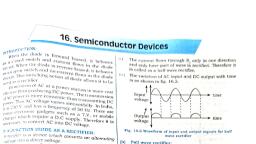
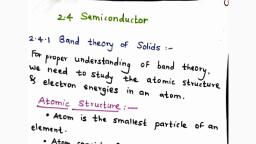
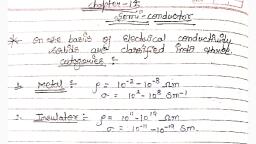
Semiconductor notes deal with a qualitative and quantitative description of semiconductors. Semiconductor notes can be for an individual course and also for a whole discipline in physics. These notes are usually given as tutorials to students before their exams, with the aim to help them consolidate their understanding of the material. The notes cover topics like energy bands, doping, and carrier transport. The basic principles are explained with diagrams and models that show how semiconductors behave in different conditions. There is also a guide to the math you need to understand these notes so you can confidently learn more about this field. Semiconductors are a group of materials used in the production of electronics. They are mainly composed of silicon and germanium. These materials have a small bandgap that allows only certain wavelengths of light to pass through them. This property is used in diodes and solar cells. Semiconductors are the best-known materials that conduct electricity with low resistance. They are very important in electronics and their uses are varied. A semiconductor is a material with an electrical conductivity that falls between that of a conductor and an insulator. The term was coined by William Whewell in 1833, who made the distinction between a conductor that could be either metal or some form of nonmetallic substance, and an insulator which is any material whose resistance to electric current was high enough to make it impractical to use it as a conductor. The types of semiconductors are - Intrinsic Semiconductors and Extrinsic Semiconductors. an intrinsic form of semiconductor material is created to be exceedingly pure. There is only a single type of element in it. The second type of semiconductor that is the extrinsic semiconductor is where the conductivity of semiconductors can be greatly improved by introducing a small number of suitable replacement atoms called impurities. Semiconductor notes come under physics notes. The objectives of semiconductor notes are - Enriching knowledge in principles of quantum mechanics and semiconductors, Developing strong fundamentals of electronic and optoelectronic materials, Enriching knowledge about measuring resistivity, conductivity, and other parameters, and Correlating principles and applications of lasers and fiber optics. Some of the modules included in Semiconductor notes are - Quantum Mechanics, Electronic materials and semiconductors, light semiconductor interaction, magnetic materials, lasers, fiber options, etc. Semiconductors are a vital component of electronic equipment, allowing for advancements in communications, computers, healthcare, military systems, transportation, clean energy, and a variety of other fields. Semiconductor notes for boards would include topics like Energy Band, Semiconductor basics, p-n junction, and Optoelectronic Devices such as solar cell, photodiode, and Zener diode. Semiconductors and communication can be treated as moderately difficult. Semiconductor notes are an important part of the Physics syllabus for NEET and JEE too.