Assignment of SMART CLASS 6th, Social Science & English Literature & English Grammar Geography Chapter 3 , Motions Of The Earth - Study Material
Page 1 :
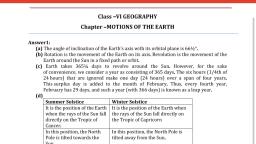
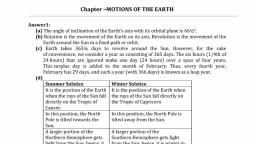
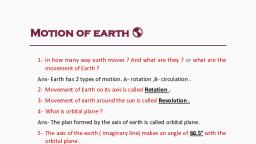
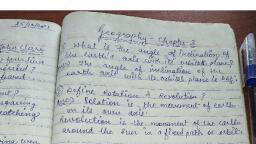
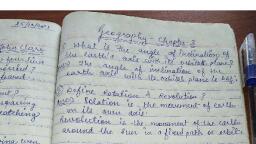
Ans. The angle of inclination of the earth's axis, is 232°. The axis forms an angle of 662° with, its orbital plane., (b) Define rotation and revolution., Ans. Rotation : The movement of the earth, on its axis in 24 hours is called rotation., Revolution : The movement of the earth, around the sun in its orbit in 365 4 days is, called revolution., (c) What is a leap year ?, Ans.A leap year is a year having one extra day,, i.e. 29th February. This happens in every four, years. The year with 366 days instead of 365, days is called leap year., (d) Differentiate between summer and, winter solstice., prime, while, INTEXT QUESTIONS, 01. What would happen if the earth did, 180, not rotate ?, Ans. Ifthe earth does not rotate, the portion, of the earth facing the sun would always, (Pages 19), Line, experience day and will be blazing hot, while, = zig. the other half would always remain in darkness, ng a, and be freezing cold. Life would not have been, the possible in such extreme conditions., te is, woid, TEXTBOOK QUESTIONS, 1. Answer the following questions briefly:, two, line, (a) What is the angle of inclination of the, earth's axis with its orbital plane ?, nd, wn, Summer Solstice, Winter Solstice, Ans., It occurs on 22nd December in, northern hemisphere., at, (1) It occurs on 21st June in northern, hemisphere., (2) Day is the longest, night is the shortest. Day is shortest, night is the longer., (3) Northern hemisphere experiences, the most heat and light., is, he, Northern hemisphere receives least, heat and light., ne, de, hemisphere is tilted towards the sun on 22nd, December, hence summer solstice occurs in, the area. At this time, northern hemisphere, (e) What is an equinox ?, Ans. Equinox is the position when on 21st, March and September 23rd, direct rays of the, sun fall on all parts of the earth. At this position, experiences winter solstice. While on 21st June,, neither of the poles is tilted towards the sun,, so the whole earth experiences equal days and, nights., () Why does the Southern Hemisphere, experience Winter and Summer solstice, in different times than that of the, Northern Hemisphere?, Ans. Southern Hemisphere experiences day and six months nignt oecause when the, summer solstice in different times than that, of the Northern Hemisphere because Southern, the northern hemisphere is tilted towards the, sun. Hence, summer solstice is seen in, northern hemisphere and winter solstice is see, in the southern hemisphere., (g) Why do the poles experience about six, month's day and six month's night ?, Ans. The poles experience about six months, northern hemisphere is tilted towards the sun,
Page 2 :
the north pole remains in light for the entire, day (24 hours). This position remains for six, months, i.e., from 21st March to 23rd, September. When the southern hemisphere is, tilted towards the sun, the south pole remains, in light for 24 hours for six months from 23rd, September to 21st March., 2. Tick the correct answers:, (a) The movement of the earth around the, sun is known as:, (i) Rotation (ii) Revolution (iii) Inclination, (b) Direct rays of the sun fall equally on, all parts of the earth on :, (i) 21st March, (iii)22nd December, (c) Christmas is celebrated in summer, in :, (i) Japan, (d) Cycle of seasons is caused due to :, (i) Rotation, (iii) Gravitation, Answers: (a) (ii) Revolution, (b) (ii) 21st March,, (c) (iii) Australia, (d) (ii) Revolution., 3. Fill in the blanks :, (ii) 21st June, (ii) India, (iii) Australia, (ii) Revolution, (a) A leap year has, days., (b) The daily motion of the earth is, --.. number of, (c) The earth travels around the sun in, ..... orbit., (d)The sun's rays fall vertically on the, tropic of, (e) Days are shorter during, ...... on 21st June., ......, season., Answers : (a) 366, (b) rotation, (c) elliptical,, (d) Cancer, (e) winter., Things To Do



 Learn better on this topic