Assignment of Saraswati Vandana, Maths & Science & English Trigonometric Functions - Study Material
Page 2 :
2 | Hydrocarbons, , Chemistry, , REACTION CHART FOR ALKENES, , Gangwar ER DR Institute, , Indira Nagar, Centre - 3, , 3rd and 4th Floor, Royal Plaza, Near Munshi pulia Petrol, Pump, Lucknow. Mob. : 8960-582-582, 9305-77-66-22
Page 6 :
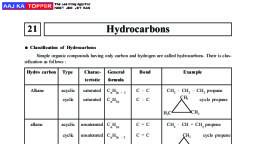
6 | Hydrocarbons, , 09, , Chemistry, , Chapter, , HYDROCARBONS, — Hydrocarbons are important sources of energy, , INTRODUCTION, , , The term ‘hydrocarbon’ is self-explanatory which means, compounds of carbon and hydrogen only., , , , If different carbon atoms are joined together to form open, chain of carbon atoms with single bonds., , , , On the other hand, if carbon atoms form a closed chain or, a ring, they are termed as cycloalkanes., , , , Hydrocarbons play a key role in our daily life., , , , The terms ‘LPG’ and ‘CNG’ used as fuels., , , , , , LPG is the abbreviated form of liquified petroleum gas, whereas CNG stands for compressed natural gas., , Unsaturated hydrocarbons contain carbon-carbon multiple, bonds – double bonds, triple bonds or both., , , , Aromatic hydrocarbons are a special type of cyclic compounds., , , , , , , Another term ‘LNG’ (liquified natural gas) is also in news, these days. This is also a fuel and is obtained by liquifaction, of natural gas., Petrol, diesel and kerosene oil are obtained by the fractional distillation of petroleum found under the earth’s crust., Coal gas is obtained by the destructive distillation of coal., Natural gas is found in upper strata during drilling of, oil wells., , , , The gas after compression is known as compressed, natural gas. LPG is used as a domestic fuel with the least, pollution., [1997], , , , Kerosene oil is also used as a domestic fuel but it causes, some pollution., , , , Automobiles need fuels like petrol, diesel and CNG. Petrol, and CNG operated automobiles cause less pollution. All, these fuels contain mixture of hydrocarbons, which are, sources of energy., , , , Hydrocarbons are also used for the manufacture of polymers like polythene, polypropene, polystyrene etc., , , , Higher hydrocarbons are used as solvents for paints. They, are also used as the starting materials for manufacture of, many dyes and drugs., , CLASSIFICATION, , , Hydrocarbons are of different types., , , , Depending upon the types of carbon-carbon bonds, present, they can be classified into three main categories –, (i) saturated (ii) unsaturated and (iii) aromatic hydrocarbons., , , , Saturated hydrocarbons contain carbon-carbon and carbon-hydrogen single bonds., , Gangwar ER DR Institute, , Indira Nagar, Centre - 3, , 1. ALKANES, 1.1 INTRODUCTION, , , As already mentioned, alkanes are saturated open chain, hydrocarbons containing carbon - carbon single bonds., , , , Methane (CH4) is the first member of this family., , , , Methane is a gas found in coal mines and marshy places., , , , If you replace one hydrogen atom of methane by carbon, and join the required number of hydrogens to satisfy the, tetravalence of the other carbon atom, what do you get?, You get C2H6., , , , This hydrocarbon with molecular formula C2H6 is known, as ethane. Thus you can consider C2H6 as derived from, CH4 by replacing one hydrogen atom by – CH3 group. Go, on constructing alkanes by doing this theoretical exercise, i.e., replacing hydrogen atom by – CH3 group. The next, molecules will be C3H8, C4H10 …, , , , These hydrocarbons are inert under normal conditions as, they do not react with acids, bases and other reagents., , , , Hence, they were earlier known as paraffins (latin : parum,, little; affinis, affinity)., , , , The general formula for alkanes is CnH2n+2, where n stands, for number of carbon atoms and 2n+2 for number of hydrogen atoms in the molecule. According to VSEPR theory,, methane has a tetrahedral structure (Fig.) which is multiplanar,, in which carbon atom lies at the centre and the four hydrogen atoms lie at the four corners of a regular tetrahedron., , 3rd and 4th Floor, Royal Plaza, Near Munshi pulia Petrol, Pump, Lucknow. Mob. : 8960-582-582, 9305-77-66-22
Page 7 :
Hydrocarbons | 7, , , , All H – C – H bond angles are of 109.5°., , , , Zn, H, CH 3 Cl H 2 , CH 4 HCl, Methane, , Chloromethane, , , Zn, H, C2 H5 Cl H 2 , C 2 H 6 HCl, Chloroethane, , Ethane, , , Zn , H, CH 3 CH 2 CH 2 Cl H 2 , CH 3 CH 2 CH 3 HCl, 1-Chloropropane, , Catalyst :, , Zn + HCl, , Fig. Structure of methane, , , In alkanes, tetrahedra are joined together in which C –, C and C – H bond lengths are 154 pm and 112 pm respectively. You have already read that C – C and C – H , bonds are formed by head-on overlapping of sp3 hybrid, orbitals of carbon and 1s orbitals of hydrogen atoms., , •, , , , Zn + CH3 COOH, , , , Zn—Cu couple in C 2H5OH, , , , Red P + HI, , , , Al + Hg + ethanol, , Mechanism :, Zn Zn +2 + 2e Q, , 1.2 METHOD OF PREPARATION, , , Petroleum and natural gas are the main sources of, alkanes., , , , However, alkanes can be prepared by following methods :, , 1., , From unsaturated hydrocarbons, , , , , Dihydrogen gas adds to alkenes and alkynes in the, presence of finely divided catalysts like platinum,, palladium or nickel to form alkanes. This process is, called hydrogenation., [2001], These metals adsorb dihydrogen gas on their surfaces and activate the hydrogen – hydrogen bond., Platinum and palladium catalyse the reaction at, room temperature but relatively higher temperature, and pressure are required with nickel catalysts., Pt / Pd / Ni, CH 2 CH 2 H 2 , CH 3 CH 3, Ethene, , Ethane, , Pt / Pd/ Ni, CH3 CH CH 2 H 2 , CH3 CH 2 CH3, Pr opene, , Pr opane, , Pt / Pd/ Ni, CH 3 C C H 2H 2 , CH 3 CH 2 CH 3, Propyne, , Propane, , Catalyst :, , , Pd/Pt at ordinary temp. and pressure, , , , Ni, 200–300° C (sabatier), , , , Raney Nickel at room temp., , , , Raney nickel is obtained by boiling Ni/Al with, NaOH. Al dissolved & Ni obtained in finally, divided state., , , , 2., , Methane can not be prepared by this method, (From unsaturated hydrocarbon)., , From Alkyl halides :, (i), , Reduction : Alkyl halides (except fluorides) on reduction with zinc and dilute hydrochloric acid give, alkanes., , Hazratganj, , Center-1, Center-2, , Propane, , , , , , 1, , 2e, R — X , R1 + X 1, , R– + H+Cl – R—H, Product, , + Cl –, , Zn +2 + 2Cl – ZnCl 2 ., , , Alkyl halides can also be reduced to alkane by, H2/Pd or LiAlH4 or H2/Ni., , , , Reduction is due to the electron transfer from, the metal to the substrate (R- X), , , , If any alkyl halide is asked, the H-atom of any, carbon atom of given alkane is removed by, halogen atom., , (ii) Wurtz Reaction : Alkyl halides on treatment with, sodium metal in dry ethereal (free from moisture) solution give higher alkanes. This reaction is known as, Wurtz reaction and is used for the preparation of, higher alkanes containing even number of carbon, atoms., [2012, NEET-2018, NEET-2020], dry ether, CH Br 2Na BrCH 3 , CH 3 CH 3 2NaBr, , 3, Bromomethane, , Ethane, dry ether, , C 2 H 5 Br 2Na BrC 2 H 5 C 2 H 5 C 2 H 5, Bromoethane, , n-butane, , A solution of alkyl halide in ether on heating with, sodium gives alkane., Dry, R — X 2 Na X — R , R — R 2 NaX, ether, , , , Two moles of alkyl halide treated with Na in presence, of dry ether. If ether is wet then we obtain alcohol., 2Na + H2O 2NaOH + H2, CH3I + NaOH CH3 OH + NaI, Methanol, , 1st Floor & 5th Floor, Pratap Bhawan, Behind Leela Cinema, Lucknow-226001, 1st Floor, 48/38 Nawal Kishore Road, Near Ram Asrey Sweets, Lucknow-226001
Page 8 :
8 | Hydrocarbons, , , , Methane can not be prepared by this method. The, alkane produced is higher and symmetrical i.e. it, contains double the number of carbon atoms, present in the alkyl halide taken., [2009], , , , Two different alkyl halides, on wurtz raction give, all possible alkanes., , , , The seperation of mixture in to individual, members is not easy because their B.P. are near, to each other and thus wurtz reaction is not, suitable for the synthesis of alkanes containing, odd number of carbon atom., , , , •, , Chemistry, , This reaction generally fails with tertiary alkyl, halide., , Mechanism : Two mechanism have been proposed for, this reaction., , , Ex., , Sol. 2, 3-Dimethyl butane., Ex., , , , 1, , 1, , 2e, R — X , R+X, , If isopropyl chloride and ethyl chloride both react with, Na in presence of dry ether which alkanes are obtained., , Sol. n-Butane, 2-Methyl butane and 2, 3-Dimethyl butane., Ex., , Which of the following compound can not obtained, from wurtz reaction., (A) ethane, (C) isobutane, , (B) butane, (D) hexane, , S ol. (C), , [Hint : In wurtz reaction unsymmetrical alkane can not be, obtained., Ex., , Ionic Mechanism:, 2Na 2Na + 2e , , , If two moles of Isopropyl chloride reacts with Na in, presence of dry ether. Which alkane is obtained., , When ethyl chloride and n-propyl chloride undergoes, wurtz reaction which is not obtained., (A) n–butane, (C) n–hexane, , (B) n–pentane, (D) isobutane, , Sol. (D), , 1, , Na, , C2H5 — Cl + C 3H7Cl C 2H5 — C2 H5 + C 3H7, , , dry ether, , , , R — X + R R — R + X –, , 2Na Å +, , 1, , 2X 1 , , — C 3H 7 + C 2 H 5 — C 3 H 7, , 2NaX, 3., , Product, , From carboxylic acids, (i), , Example :, 2C 2H5 —I + 2Na C 2H5—C 2 H5 + 2NaI, , Decarboxylation :, , , Sodium salts of carboxylic acids on heating with, soda lime (mixture of sodium hydroxide and calcium oxide) give alkanes containing one carbon atom less than the carboxylic acid., , , , This process of elimination of carbon dioxide from a carboxylic acid is known as decarboxylation., , n–butane, , , Free radical mechanism :, Na Na + e , , , , , 1, , ., , e, R — X , R+X, , 1, , CaO, CH 3 COO Na NaOH , CH 4 Na 2 CO 3, , , R R R — R Product, , Sodium ethanoate, , , , , , , , Na X NaX, , , , Free radicals also undergo Disproportionation i.e., one radical gains hydrogen at the expense of the, other which loss hydrogen., , Replacement of – COOH by hydrogen is, known as decarboxylation., , , , The alkane formed always contains one, carbon atom less than the original acid., , , , This reaction is employed for stepping down, a homologous series., , , , Soda lime is prepared by soaking quick lime CaO, with NaOH solution and then drying the products., , , , Decarboxylation of sodium formate gives H2, , H, ., , ., , ., , ., , CH 2 — CH 2 + C2 H 5 C2H 6, Ethane, Ethylene, , , +, , C 2H 4, , This explains the presence of ethylene and, eth an e i n th e but an e obt ai ned by Wurt z, reaction., , Ex., , How many acids can be taken to obtain isobutane from, decarboxylation?, (A) 4, , Gangwar ER DR Institute, , Indira Nagar, Centre - 3, , (B) 3, , 3rd and 4th Floor, Royal Plaza, Near Munshi pulia Petrol, Pump, Lucknow. Mob. : 8960-582-582, 9305-77-66-22
Page 10 :
10 | Hydrocarbons, , Chemistry, , R—X + 2Zn +RX R2Zn + ZnX 2, Frankland reagent, 3., , R2Zn + R—X R—R + RZnX, From alkanones (By Clemmensen's method):, Carbonyl compound (Preferably ketones) may also be, reduced with Zinc amalgam and concentrated HCl, (Zn—Hg/HCl), this reaction is called Clemmensen, reduction., [JEE-2004], , molecular weight., , , Li qui d a lka nes ar e t hemselves good n on-pol ar, solvents., , , , Boiling point - µ molecular weight (for n-alkanes), , , , molecular weight, , O+NH2NH2 C, Hydrazine, Glycol / KOH, , , , , , 5., , R, , Mg, , X+H, , O, , H R, , H + Mg (OH) X, , +R, , O, , H R, , H + Mg (OR) X, , NH, , H R, , H + Mg (NHR) X, , +R, , (b), , This reaction is used to determine the number, of active H-atoms in the compound this is known, as Zerewitnoff's method., [JEE-2016], G.R. react with alkyl halide to give higher, alkanes :, RMgX + R'—X R—R' + MgX 2, , 1.4, , PHYSICAL PROPERTIES :, , , , C1 to C 4 gases, Neopentane also gas but n-pentane, and isopentane are low B.P. liquids., , , , The abnormal trend in M.P. is due to the fact that, alkanes with odd carbon atoms have their carbon atom, on the same side of the molecule and in even carbon, atom alkane the end Carbon atom on opposite side., Thus alkanes with even carbon atoms are packed, cl osel y i n cr yst al l a tt i ce t o per m i t gr eat er, intermolecular attractions., C, C, , C, C, , C, C, , C, , <, , Odd number of carbon, , C, C, , C, C, , C, C, , Even number of carbon, , 1.5 CHEMICAL PROPERTIES :, , As already mentioned, alkanes are generally inert, towards acids, bases, oxidising and reducing agents. However,, they undergo the following reactions under certain conditions., 1., , Substitution reactions, , Density : The density of alkanes increases with, increase in molecular weight and becomes constant, at 0.8 g/mL. Thus all alkanes are lighter than water., , One or more hydrogen atoms of alkanes can be, replaced by halogens, nitro group and sulphonic, acid group., , , , Solubility : Alkanes being non polar and thus insoluble, in water but soluble in non-polar solvents. [2011], , Halogenation takes place either at higher temperature (573-773 K) or in the presence of diffused sunlight or ultraviolet light., , , , Lower alkanes do not undergo nitration and, sulphonation reactions., , , , These reactions in which hydrogen atoms of alkanes, are substituted are known as substitution reactions., , Next members C 5 to C17 are Colourless liquids and, above C17 are Waxy solids., , , , Example: C 6H6, CCl 4 ,ether etc., , , Melting Point : M.P. of alkanes do not show, regular trend. Alkanes with even number of carbon, atoms have higher M.P. than their alkanes of odd, number of carbon atoms., , , , , , , , , , CH2 + N 2, , From Grignord Reagent :, (a) Formation of alkanes with same number of C, atoms : With same number of C-atoms as G.R., react with compound containing active hydrogen, alkanes is obtained., , number of side chain, , T hus boi l in g poi n t n–Pen ta n e > Isopen t an e >, neopentane, [2013], , N.NH2, , Hydrazone, , 1, , because the shape approaches to spherical which, results in decrease in Vanderwaals forces (as surface, area decreases), , CH2 group., , From alkanals and alkanones (By Wolf Kishner, reaction) :, C, , surface area of molecule., , Also boiling point , , CH4, CH3—CH3, isobutane and neopentane are not, obtained from Ketones because these alkane do not, , 4., , , , , , i.e. boiling point Pentane < hexane < heptane, , Zn / Hg, R—CH —R'+H O, R—CO—R'+4H , 2, 2, con .HCl, , contain, , Vanderwaals force of attraction, , The solubility of alkanes decreases with increase in, , Gangwar ER DR Institute, , Indira Nagar, Centre - 3, , 3rd and 4th Floor, Royal Plaza, Near Munshi pulia Petrol, Pump, Lucknow. Mob. : 8960-582-582, 9305-77-66-22
Page 11 :
Hydrocarbons | 11, , As an example, chlorination of methane is given, below:, Halogenation, , , , hv, C H 3 Cl Cl , CH3 Cl , , , , hv, CH 4 Cl 2 , CH 3 Cl HCl, Chloromethane, hv, , CH 3 Cl Cl 2 CH 2 Cl 2 HCl, Dichloromethane, , , , hv, CH 2 Cl 2 Cl 2 , CHCl3 HCl, Trichloromethane, hv, , CHCl3 Cl2 , , CCl, , 4, Tetrachloromethane, , HCl, , Chlorine free radical, , The chlorine and methyl free radicals, generated above repeat steps (i) and (ii), respectively and thereby setup a chain, of reactions., The propagation steps (i) and (ii) are, those which directly give principal products, but many other propagation steps, are possible and may occur., , , hv, CH 3 CH 3 Cl 2 , CH 3 CH 2 Cl HCl, , , , Cl, , , , CH 3 Cl C l C H 2 Cl HCl, , Chloroethane, , , , , , It is found that the rate of reaction of alkanes with, halogens is F2 > Cl2 > Br2 > I2., , , , Rate of replacement of hydrogens of alkanes is : 3°, > 2° > 1°., , , , Fluorination is too violent to be controlled., , , , Iodination is very slow and a reversible reaction. It, can be carried out in the presence of oxidizing agents, like HIO3 or HNO3., , (iii) Termination : The reaction stops after some, time due to consumption of reactants and / or, due to the following side reactions :, , The possible chain terminating steps are :, , , , , , , , , , , – H3 C C H3 H 3 C CH 3, – H3 C C l H 3 C Cl, , , HIO3 5HI , 3I 2 3H 2 O, , Halogenation is supposed to proceed via free radical chain mechanism involving three steps namely, initiation, propagation and termination as given, below:, , , , Mechanism :, (i), , , , – C l C l Cl Cl, , CH 4 I 2 , CH 3 I HI, , , , , , C H 2 Cl Cl Cl CH 2 Cl 2 C l, , Though already, CH3 – Cl, the one of the, products is formed but free radicals are, consumed and the chain is terminated., The above mechanism helps us to understand the reason for the formation of, ethane as a byproduct during chlorination, of methane., [2004], , Initiation :, , , The reaction is initiated by homolysis of, chlorine molecule in the presence of light, or heat., , , , The Cl – Cl bond is weaker than the C – C, and C – H bond and hence, is easiest to, break., , hv, Cl Cl , Cl , hom olysis, , , , 1.6 Reactivity selectivity Principle :, , , Probability factor : The factor is based on the, number of each kind of H atom in the molecule., , , , For example is CH3—CH2—CH2—CH3 there are six, equivalent 1° H's and four equivalent 2° H's., , , , The probability of abstracting 1° H's to 2° H's is 6 to 4., i.e., 3 to 2., , , , Reactivity of halogen free radical : the more, reactive chlorine free radical is less selective and, more influenced by the probability factor. On the, other hand, the less reactive Br radical is more, selective and less influenced by the probability, factor (Reactivity selectivity principle)., , , , Reactivity of alkanes (ease of abstration of 'H', atoms) : Sin ce t he r at e determ in in g st ep i n, halogenations is abstraction of hydrogen by a, , Cl, , Chlorine free radicals, , (ii) Propagation : Chlorine free radical attacks the, methane molecule and takes the reaction, in the forward direction by breaking the C – H, bond to generate methyl free radical with the, formation of H – Cl., , , , , Hazratganj, , , , hv, CH 4 C l , C H3 H Cl, The methyl radical thus obtained attacks the second molecule of chlorine to, form CH3 – Cl with the liberation of another chlorine free radical by homolysis, of chlorine molecule., , Center-1, Center-2, , 1st Floor & 5th Floor, Pratap Bhawan, Behind Leela Cinema, Lucknow-226001, 1st Floor, 48/38 Nawal Kishore Road, Near Ram Asrey Sweets, Lucknow-226001
Page 12 :
12 | Hydrocarbons, , , , , , Chemistry, , halogen atom be the formation of alkyl radical,, halogenation of alkanes follows order of stability of, free radical is 3° > 2° > 1° > CH3., Reactivity ratio of H atom for Chlorination, (1° : 2° : 3° H), 1 : 3.8 : 5, Reactivity ratio of H atom for bromination, (1 : 82 : 1600), The above order of stability of radicals is due to the, ease of their formation from the corresponding alkane, which in turn is due to difference in the value of, H., , , , Incomplete, CH 4 (g) O 2 (g) , C(s) 2H 2 O(l ), combustion, , 3., , Controlled oxidation :, , , CH3—H CH3 H H1, CH3—CH2—H CH3 — CH2 H H 2, CH3—CH—CH3, , During incomplete combustion of alkanes with insufficient amount of air or dioxygen, carbon black is, formed which is used in the manufacture of ink, printer, ink, black pigments and as filters., , Alkanes on heating with a regulated supply of, dioxygen or air at high pressure and in the presence of, suitable catalysts give a variety of oxidation, products., (i), , Cu /523K /100 atm, 2CH 4 O 2 , 2CH 3 OH, , (ii), , Mo O, CH 4 O2 , HCHO H 2 O, , , (iii), , (CH COO) Mn, 2CH 2 CH3 3O 2 , , , , Methanol, 2, , 3, , Methanal, 3, , CH3—CH—CH3+H H 3, , 2, , 2CH 3 COOH 2H 2 O, Ethanoic acid, , H, , CH3—C—CH3, , , , CH3, , CH3, , CH 3—C—CH 3+H H, 4, , H, , , , , 2., , KMnO, (CH 3 )3 CH , (CH 3 )3 COH, Oxidation, 4, , Reactivity of any H-atom number of H atoms of, that kind × reactivity of that H., [JEE-2005], Thus the amount of energy required to form the, various classes of radicals decreases in the order, CH3 > 1° > 2° > 3° (H 1 >H 2 >H 3 > H4 )., Therefore, it easiest to form 3° radical and it is, most difficult to form CH3. We can also interpret, this in an alternative way the case of abstraction of, H atoms from hydrocarbon fallows the sequence 3°, > 2° > 1° CH4 which should also be the case of, formation of free radicals., [AIPMT-2006], Combustion, , Alkanes on heating in the presence of air or dioxygen, are completely oxidized to carbon dioxide and water, with the evolution of large amount of heat., CH 4 (g) 2O 2 (g) , CO 2 (g) 2H 2 O(l );, , 2-Methylpropane, , 4., , , , n-Alkanes on heating in the presence of anhydrous, aluminium chloride and hydrogen chloride gas, isomerise to branched chain alkanes., , , , Major products are given below. Some minor products are also possible which you can think over., , , , Minor products are generally not reported in organic reactions., Anhy. AlCl / HCl, CH 3 (CH 2 )4 CH 3 , 3, , n-Hexane, , CH3CH – (CH2)2 – CH3 + CH3CH2 – CH – CH2 – CH3, , 5., , , , CH3, , CH3, , 2-Methylpentane, , 3-Methylpentane, , Aromatization :, , , n-Alkanes having six or more carbon atoms on heating to 773K at 10-20 atmospheric pressure in the presence of oxides of vanadium, molybdenum or chromium supported over alumina get dehydrogenated, and cyclised to benzene and its homologues., , , , This reaction is known as aromatization or, reforming., [2014], , 13, O2 (g) , 4CO 2 (g) 5H 2 O(l );, 2, , e H 2875.84 kJ mol 1, The general combustion equation for any alkane is :, , 2-Methylpropan-2-ol, , Isomerisation :, , e H 890 kJ mol 1, , C4 H10 (g) , , Ordinarily alkanes resist oxidation but alkanes having tertiary H atom can be oxidized to corresponding, alcohols by potassium permanganate., , 3n 1 , Cn H2n 2 , nCO2 (n 1)H2 O, O2 , 2 , , , Due to the evolution of large amount of heat during, combustion, alkanes are used as fuels., , Gangwar ER DR Institute, , Indira Nagar, Centre - 3, , 3rd and 4th Floor, Royal Plaza, Near Munshi pulia Petrol, Pump, Lucknow. Mob. : 8960-582-582, 9305-77-66-22
Page 13 :
Hydrocarbons | 13, , Toluene (C7H8) is methyl derivative of benzene., , , , 6., , Reaction with steam :, Methane reacts with steam at 1273 K in the presence of nickel catalyst to form carbon monoxide and, dihydrogen., , , , (c), , The staggered conformation of ethane is more stable, than eclipsed conformation, because staggered, conformation has no torsional strain, , (d), , The staggered conformation of ethane is less stable, than eclipsed conformation, because staggered, conformation has torsional strain., , This method is used for industrial preparation of, dihydrogen gas., , , , Ni, CH 4 H 2 O , CO 3H 2, , , 7., , than staggered conformation even though the, eclipsed conformation has torsional strain, , Pyrolysis, , 4., [2010], , In the following the most stable conformation of n-butane, is :[AIPMT-2010], H, (a), , Such a decomposition reaction into smaller fragments by the application of heat is called pyrolysis or, cracking., , , , Pyrolysis of alkanes is believed to be a free radical, reaction., , , , Preparation of oil gas or petrol gas from kerosene oil, or petrol involves the principle of pyrolysis., , , , For example, dodecane, a constituent of kerosene oil, on heating to 973K in the presence of platinum, palladium or nickel gives a mixture of heptane and pentene., , 5., , Heptane, , 1., , 2., , (c), 3., , CH3 – CH3, , (b), (d), , CH CH, , CH3, CH3, , CH3, H, (d), , H, , H, , H, H, , H3C, , (b), , Cracking, , (c), , Distillation under reduced pressure, , (d), , hydrolysis, , (C5 H11Cl), , Fractional, , M (isomeric product), distillation, , The values of Nand Mare :, , 7., , [AIPMT-2006], , (a), , 3, 3, , (b), , 4, 4, , (c), , 6, 6, , (d), , 6, 4, , What would be the product formed when l-bromo-3-chloro, cyclobutane reacts with two equivalents of metallic, sodium in ether?, [AIPMT-2005], , CH2 = CH2, , Cl, (a), , CH4, , Br, , (c), , (b), (d), , [NEET-2016, Phase-I], , (b), , The eclipsed conformation of ethane is more stable, than staggered conformation, because eclipsed, conformation has no torsional strain, The eclipsed conformation of ethane is more stable, , Hazratganj, , Center-1, Center-2, , H, , Cl2 , hv, Me , N (isomeric products), , Me, , The correct statement regarding the comparison of, staggered and eclipsed conformations of thane, is :(a), , H, , Me, , Which of the following alkane cannot be made in good, yield by Wurtz reaction?, [NEET-2020], (a) 2, 3-Dimethylbutane (b) n-Heptane, (c) n-Butane, (d) n-Hexane, , (a), , CH3, , Oxidation, , 6., , Hydrocarbon (A) reacts with bromine by substitution to, form an alkyl bromide which by Wurtz reaction is converted to gaseous hydrocarbon containing less than four, carbon atoms (A) is, [NEET-2018], , H, , H, , (a), , Pentane, , Check Your Progress - 01, , (b), , H, , H, , Liquid hydrocarbons can be converted to a mixture of, gaseous hydrocarbons by [AIPMT - 2010], , Pt / Pd/ Ni, C12 H 26 , C7 H16 C5 H10 other products, 973 K, Dodecane, , H, H, , H, , CH3, , H, , (c), , , CH3, , CH3, , Higher alkanes on heating to higher temperature decompose into lower alkanes, alkenes etc., , , , 8., , The IUPAC name of, , is, , (a), , 3-ethyl-4-4-dimethylheptane, , (b), , 1, 1-diethyl-2,2-dimethylpentane, , 1st Floor & 5th Floor, Pratap Bhawan, Behind Leela Cinema, Lucknow-226001, 1st Floor, 48/38 Nawal Kishore Road, Near Ram Asrey Sweets, Lucknow-226001
Page 14 :
14 | Hydrocarbons, , 9., , 10., , 11., , 12., , Chemistry, , (c), , 4, 4-dimethyl-5,5-diethylpentane, , (d), , 5, 5-diethyl-4,4-dimethylpentane., , 5., , Which one is not prepared by Wurtz reaction?, , [JEE-2007], , (a), , C4H8, , Of the five isomeric hexanes, the isomer which can give, two monochlorinated compounds is :, [JEE-2005], , (c), , CH4, , (a), , n-hexane, , (b), , 2,3-dimethylbutane, , (c), , 2,2-dimethylbutane, , (d), , 2-methylpentane, , CH3 CH3, , (a), , 2, , (b), , 4, , (d) CH3 CH CH CH3, In the following compounds the decreasing order of B.P., is, n-hexane,, Iso-hexane, Neo hexane, (I), (II), (III), , (c), , 6, , (d), , 8, , (a), , (I) > (II) > (III), , (b), , (I) > (III) > (II), , (c), , (II) > (III) > (I), , (d), , (III) > (II) > (I), , 6., , How many chiral compound are possible on mono chlorination of 2-methyl butane ?, [JEE-2004], , Which one of the following has the minimum boiling, point?, [JEE-2004], (a), , n-Butane, , (b) 1-Butyne, , To prepare a pure sample of n-hexane using sodium, metal as one reactant, the other reactant will be, , (c), , 1-Butene, , (d) Isobutene, , (a), , Ethyl chloride and n-butyl chloride, , Which one of the following is reduced with zinc and hydrochloric acid to give the corresponding hydrocarbon?, , (b), , Methyl chloride and n-pentyl bromide, , (c), , Ethyl bromide and n-butyl bromide, , [JEE-2004], , (d), , n-propyl bromide, , (a), , Ethyl acetate, , (b), , Acetic acid, , (c), , Acetamide, , (d), , Butan-2-one, , 7., , 8., , The reagent used for the conversion, , A, , 2., , 3., , 4., , CH3CH2CH3, , CH3CH2COOH, , Home Practice Questions (HPQ-01), 1., , (b), , B, , CH3CH3, , Bromination of an-alkane as compared to chlorination, proceeds, , (A) & (B) are respectively, (a), , LiAlH4 & soda lime, , (a), , At a slower rate, , (b), , Zn(Hg)/HCl, Red P +HI, , (b), , At a faster rate, , (c), , Red P + HI & Soda lime, , (c), , With equal rates, , (d), , Soda lime & Red P + HI, , (d), , With equal or different rates depending upon the, temperature, , The product obtained on heating n-heptane with, Cr 2O3 – Al2O3 at 600° C in, (a) Cyclohexane, (b) Cyclotrihexene, (c) Toluene, (d) Cyclo heptane, Which of the following will have least hindered rotation, about carbon-carbon bond?, (a) Ethane, (b) Ethylene, (c) Acetylene, (d) Hexachlero ethane, The reaction condition leading to the best yield of, C2H5Cl are, (a), , 9., , 10., , Which of the following liberates methane on treatment, with water?, (a), , Silicon Carbide, , (b), , Calcium Carbide, , (c), , Beryllium Carbide, , (d), , Magnesium Carbide, , 2-methyl butane on reacting with bromine in the presence, of sunlight gives maximum content of, (a), , 1-bromo-3-methyl butane, , (b), , 2-bromo 3-methyl butane, , (c), , 2-bromo 2-methyl butane, , (d), , 1-bromo-2-methyl butane, , 2. ALKENES, , uv, C2 H 6 Cl2 , , light, , (Excess), , 2.1 INTRODUCTION, , (b), , dark, C 2 H 6 Cl 2 , , , (c), , uv, C 2 H 6 Cl2 , , , (d), , room temp., , Excess, , light, , uv, , C2 H 6 HCl , light, , Gangwar ER DR Institute, , Indira Nagar, Centre - 3, , , , Alkenes are unsaturated hydrocarbons containing at least, one double bond., , , , If there is one double bond between two carbon atoms in, alkenes, they must possess two hydrogen atoms less than, alkanes. Hence, general formula for alkenes is CnH2n., , 3rd and 4th Floor, Royal Plaza, Near Munshi pulia Petrol, Pump, Lucknow. Mob. : 8960-582-582, 9305-77-66-22
Page 15 :
Hydrocarbons | 15, , , , Alkenes are also known as olefins (oil forming) since the, first member, ethylene or ethene (C2H4) was found to form, an oily liquid on reaction with chlorine., , form trans alkenes., (i), , Structure of Double Bond, , , , , , , Carbon-carbon double bond in alkenes consists of, one strong sigma ( ) bond (bond enthalpy about, 397 kJ mol–1) due to head-on overlapping of sp2, hybridised orbitals and one weak pi ( ) bond (bond, enthalpy about 284 kJ mol–1) obtained by lateral or, sideways overlapping of the two 2p orbitals of the, two carbon atoms., The double bond is shorter in bond length (134 pm), than the C – C single bond (154 pm). You have already read that the pi ( ) bond is a weaker bond due, to poor sideways overlapping between the two 2p, orbitals. Thus, the presence of the pi (p) bond makes, alkenes behave as sources of loosely held mobile, electrons. Therefore, alkenes are easily attacked by, reagents or compounds which are in search of electrons. Such reagents are called electrophilic reagents., , (ii), , (iii), , [NEET-2016], 2., , The presence of weaker -bond makes alkenes unstable molecules in comparison to alkanes and thus,, alkenes can be changed into single bond compounds, by combining with the electrophilic reagents., Strength of the double bond (bond enthalpy, 681 kJ, mol–1) is greater than that of a carbon-carbon single, bond in ethane (bond enthalpy, 348 kJ mol–1). Orbital diagrams of ethene molecule are shown in Figures., , 2.2 PREPARATION, , From alkyl halides :, , , Alkyl halides (R – X) on heating with alcoholic potash (potassium hydroxide dissolved in alcohol, say,, ethanol) eliminate one molecule of halogen acid to, form alkenes., [NEET-2020], , , , This reaction is known as dehydrohalogenation i.e.,, removal of halogen acid., , , , This is example of -elimination reaction, since, hydrogen atom is eliminated from the carbon atom, (carbon atom next to the carbon to which halogen is, attached)., , , , Nature of halogen atom and the alkyl group determine rate of the reaction., , , , It is observed that for halogens, the rate is: iodine, > bromine > chlorine, while for alkyl groups it is : tert, > secondary > primary., , From vicinal dihalides :, , , Dihalides in which two halogen atoms are attached, to two adjacent carbon atoms are known as vicinal, dihalides., , , , Vicinal dihalides on treatment with zinc metal lose a, molecule of ZnX2 to form an alkene. This reaction is, known as dehalogenation., , From alkynes :, Alkynes on partial reduction with calculated amount, of dihydrogen in the presence of palladised charcoal, partially deactivated with poisons like sulphur compounds or quinoline give alkenes., , , , Partially deactivated palladised charcoal is known as, Lindlar’s catalyst., , , , Alkenes thus obtained are having cis geometry., , , , Alkynes on reduction with sodium in liquid ammonia, , Hazratganj, , Center-1, Center-2, , Ethene, , C CH H 2 , CH 3 CH CH 2, (iv) CH 3 Propyne, Propene, , Fig. Orbital picture of ethene, depicting bonds only, , , , Ethyne, , Pd/ C, , 3., , 1., , Pd / C, CH CH H 2 , CH 2 CH 2, , CH 2 Br CH 2 Br Zn CH 2 CH 2 ZnBr2, CH 3CHBr CH 2 Br Zn CH 3CH CH 2 ZnBr2, 4., , From alcohols by acidic dehydration :, , , Alcohols on heating with concentrated sulphuric, acid form alkenes with the elimination of one water, molecule., , , , Since a water molecule is eliminated from the alco-, , 1st Floor & 5th Floor, Pratap Bhawan, Behind Leela Cinema, Lucknow-226001, 1st Floor, 48/38 Nawal Kishore Road, Near Ram Asrey Sweets, Lucknow-226001
Page 16 :
16 | Hydrocarbons, , Chemistry, , hol molecule in the presence of an acid, this reaction, is known as acidic dehydration of alcohols., , , , , This reaction is also the example of -elimination, reaction since – OH group takes out one hydrogen, atom from the -carbon atom., , electrons, due to which they show addition reactions, in which the electrophiles add on to the carbon-carbon double bond to form the addition products., Chemical reactions of alkenes : (Mechanism), , , Due to presence of weak p electrons in alkene and, alkyne, they give electrophilic addition., , , , , , Markovnikov rule : The rule states that the negative part of the attacking species add on the carbon atom containing less number of hydrogen, atom., Mechanism :, , , , Reactivity of an Alkene:, , Ease of dehydration of alcohol 3° > 2° > 1°, , More stable alkene is formed as major product., Saytzeff Rule : When two possible alkenes are obtained, by the elimination reaction than that alkene will be in good, yield, containing maximum number of alkyl group on double, bonded C-atoms., , , 5., , By Kolbe's Electrolytic synthesis :, , Electrolysis, , + H2O , Current, , CH2, ||, CH2, , + 2CO2 + 2KOH + H2, 2.3 PROPERTIES, , , Physical properties, , , , , The first three members are gases, , , , The next fourteen are liquids and the higher ones are, solids., , , , Ethene is a colourless gas with a faint sweet smell., , , , All other alkenes are colourless and odourless, insoluble in water but fairly soluble in nonpolar solvents like benzene, petroleum ether., , , , , , , , Alkenes as a class resemble alkanes in physical properties, except in types of isomerism and difference, in polar nature., , They show a regular increase in boiling point with, increase in size i.e., every – CH2 group added increases boiling point by 20–30 K., , Presence of e– releasing groups (+m, +I) at, C=C increases reactivity., , 2., , Presence of ERG stabilises the intermediate, carbocation., , Examples of Reactivity Orders:- [AIPMT-2005], >, , (i), , >, , >, , >, , Like alkanes, straight chain alkenes have higher boiling point than isomeric branched chain compounds., , Chemical properties, , , , , 1., , Alkenes are the rich source of loosely held pi ( ), , Gangwar ER DR Institute, , Indira Nagar, Centre - 3, , >, , 3rd and 4th Floor, Royal Plaza, Near Munshi pulia Petrol, Pump, Lucknow. Mob. : 8960-582-582, 9305-77-66-22, , >
Page 18 :
18 | Hydrocarbons, , Chemistry, , , , The rule states that negative part of the addendum (adding molecule) gets attached to that, carbon atom which possesses lesser number of, hydrogen atoms. Thus according to this rule,, product I i.e., 2-bromo-propane is expected., , , , In actual practice, this is the principal product of the reaction., , , , This generalisation of Markovnikov rule can, be better understood in terms of mechanism of, the reaction., , [AIPMT-2004], , (iii), , (iv), , MECHANISM, , , Hydrogen bromide provides an electrophile, H+, which attacks the double bond to form carbocation as shown below :, (v), , (i), , (ii), , The secondary carbocation (b) is more stable than, the primary carbocation (a), therefore, the former, predominates because it is formed at a faster rate., The carbocation (b) is attacked by Br– ion to form the, product as follows :, , Anti Markovnikov addition or peroxide effect or, Kharash effect, [2004], , , In the presence of peroxide, addition of HBr to, unsymmetrical alkenes like propene takes place, contrary to the Markovnikov rule., , , , This happens only with HBr but not with HCl, and Hl. This addition reaction was observed, by M.S. Kharash and F.R. Mayo in 1933 at the, University of Chicago., , , , This reaction is known as peroxide or Kharash, effect or addition reaction anti to Markovnikov rule., , 4., , , , The secondary free radical obtained in the above, mechanism (step iii) is more stable than the, primary., , , , This explains the formation of 1-bromopropane as, the major product., , , , It may be noted that the peroxide effect is not observed in addition of HCl and HI., , , , This may be due to the fact that the H – Cl bond, being stronger (430.5 kJ mol–1) than H – Br bond (363.7, kJ mol–1), is not cleaved by the free radical, whereas, the H – I bond is weaker (296.8 kJ mol–1) and iodine, free radicals combine to form iodine molecules instead of adding to the double bond., , Addition of sulphuric acid : Cold concentrated sulphuric, acid adds to alkenes in accordance with Markovnikov, rule to form alkyl hydrogen sulphate by the electrophilic, addition reaction., , MECHANISM : Peroxide effect proceeds via free radical, chain mechanism as given below:, , (i), , (ii), , , , , , Homolysis, C 6 H 5 H Br , C6 H 6 B r, , Gangwar ER DR Institute, , Indira Nagar, Centre - 3, , 3rd and 4th Floor, Royal Plaza, Near Munshi pulia Petrol, Pump, Lucknow. Mob. : 8960-582-582, 9305-77-66-22
Page 20 :
20 | Hydrocarbons, , , , Chemistry, , Polythene is obtained by the combination of large, number of ethene molecules at high temperature, high, pressure and in the presence of a catalyst., , , , The large molecules thus obtained are called polymers., , , , This reaction is known as polymerisation., , , , The simple compounds from which polymers are made, are called monomers. Other alkenes also undergo, polymerisation., , NCS = N-Chlorosuccinimide, , , , DIENES, 1., , Dienes are of three types :, (a), , Isolated dienes : eg. CH2=CH–CH2–CH=CH2, , (b), , Conjugated dienes : eg. CH2=CH–CH=CH=CH3, , (c), , Cumulated dienes : eg. CH3–CH=C=CH–CH3, , 2., , Stability Order : Conjugated > Isolated > Cumulene, , 3., , Heat of Hydrogenation :, Cumulated > terminal alkyne > nonterminal alkyne >, isolated diene > conjugated diene, , , , 2.4, , 4., , Polymers are used for the manufacture of plastic bags,, squeeze bottles, refrigerator dishes, toys, pipes, radio and T.V. cabinets etc. Polypropene is used for the, manufacture of milk crates, plastic buckets and other, moulded articles. Though these materials have now, become common, excessive use of polythene and, polypropylene is a matter of great concern for all of, us., , General Reaction :, , [JEE-2005], , Reaction take place at two position (1, 2) and (1, 4),, major product depends on reaction temperature., , OTHER REACTIONS, (i), , Addition of NOCl, , [AIIMS-2008], N Cl, , O, , CH3 – CH = CH2 , , Check Your Progress - 02, 1., (Ii) Addition of HOCl, , [JEE-2016], , I., , HOCl CH — CH — CH, CH3 – CH = CH2 , 3, 2, , OH, , Elimination reaction of 2-Bromo-pentane to form pent2-ene is :, [NEET-2020], , Cl, , (ii) Halogenation. Allylic substitution :, General Reaction, 2., , -Elimination reaction, , II. Follows Zaitsev rule, III. Dehydrohalogenation reaction, IV. Dehydration reaction, (a) I, III, IV, (b) II, III, IV, (c) I, II, IV, (d) I, II, III, An alkene on ozonolysis gives methanal as one of the, product. Its structure is :, [NEET-2020 (PHASE-II], , X2 = Cl2, Br2, , NBS = N-Bromosuccinimide, , Gangwar ER DR Institute, , (a), , (b), , (c), , (d), , ;, , Indira Nagar, Centre - 3, , 3rd and 4th Floor, Royal Plaza, Near Munshi pulia Petrol, Pump, Lucknow. Mob. : 8960-582-582, 9305-77-66-22
Page 24 :
24 | Hydrocarbons, , Chemistry, , C – H bonds and two C – C bonds. The strength of, C C bond (bond enthalpy 823 kJ mol–1) is more than, those of C = C bond (bond enthalpy 681 kJ mol–1) and C –, C bond (bond enthalpy 348 kJ mol–1). The C C bond, length is shorter (120 pm) than those of C = C (133 pm) and, C – C (154 pm)., , 3. ALKYNES, 3.1 INTRODUCTION, , , , , , , Like alkenes, alkynes are also unsaturated hydrocarbons., They contain at least one triple bond between two carbon, atoms. The number of hydrogen atoms is still less in alkynes, as compared to alkenes or alkanes. Their general formula, is CnH2n–2., The first stable member of alkyne series is ethyne which is, popularly known as acetylene., Acetylene is used for arc welding purposes in the form of, oxyacetylene flame obtained by mixing acetylene with oxygen gas. Alkynes are starting materials for a large number, of organic compounds. Hence, it is interesting to study, this class of organic compounds., , 3.2 STRUCTURE OF TRIPLE BOND, , Ethyne is the simplest molecule of alkyne series., Structure of ethyne is shown in Fig., , Each carbon atom of ethyne has two sp hybridised orbitals., , Carbon-carbon sigma (s) bond is obtained by the headon overlapping of the two sp hybridised orbitals of the, two carbon atoms., , The remaining sp hybridised orbital of each carbon atom, undergoes overlapping along the internuclear axis with, the 1s orbital of each of the two hydrogen atoms forming, two C – H sigma bonds., , H – C – C bond angle is of 180°., , Each carbon has two unhybridised p orbitals which are, perpendicular to each other as well as to the plane of the C, – C sigma bond., , The 2p orbitals of one carbon atom are parallel to the 2p, orbitals of the other carbon atom, which undergo lateral or, sideways overlapping to form two pi ( ) bonds between, two carbon atoms., , , , Electron cloud between two carbon atoms is cylindrically, symmetrical about the internuclear axis. Thus, ethyne is a, linear molecule., , 3.3 PREPARATION, 1., , From calcium carbide :, , , On industrial scale, ethyne is prepared by treating, calcium carbide with water., , , , Calcium carbide is prepared by heating quick lime, with coke. Quick lime can be obtained by heating, limestone as shown in the following reactions:, , CaCO 3 , CaO CO 2, , CaO 3C , CaC 2 CO, Calcium carbide, , CaC2, 2., , 3., , 2H2O, , Ca(OH)2, , C2H2, , From vicinal dihalides :, , , Vicinal dihalides on treatment with alcoholic potassium hydroxide undergo dehydro-halogenation., , , , One molecule of hydrogen halide is eliminated to, form alkenyl halide which on treatment with sodamide, gives alkyne., , From Gem dihalides (by dehydrohalogenation) :, , , Dehydrohalogenation agents are : NaNH 2, (Sodamide) or Alc. KOH or ROH + RONa., H, , R C, H, , X, , X, alc. KOH, , R C, CH , HX , , X, , NaNH, , 2, , CH , , H, , (Stable by resonance), R—C, , , Fig.: Orbital picture of ethyne showing, (a) sigma overlaps (b) pi overlaps., , , Thus ethyne molecule consists of one C – C bond, two, , Gangwar ER DR Institute, , Indira Nagar, Centre - 3, , CH + NaX + NH3 (Vinyl halide), , Due to stability of vinyl halide by resonance there, is partial double bond in which elimination does, not take place by alc. KOH so stronger base, NaNH2 is used., , 3rd and 4th Floor, Royal Plaza, Near Munshi pulia Petrol, Pump, Lucknow. Mob. : 8960-582-582, 9305-77-66-22
Page 25 :
Hydrocarbons | 25, , , , , Basic strength : N H 2 is stronger base then RO , , , , Trans elimination takes place in forming of, alkynes., , 4., , From Kolbe's electrolysis : By the electrolysis of, aqueous solution of sodium or potassium fumarate or, maleate, acetylene is formed at anode., , , , Their melting point, boiling point and density increase, with increase in molar mass., , Chemical properties, Alkynes show acidic nature, addition reactions and, polymerisation reactions as follows :, A., , Acidic character of alkyne :, , , Sodium metal and sodamide (NaNH2) are strong, bases., , , , They react with ethyne to form sodium acetylide, with the liberation of dihydrogen gas., , CH, , CH COOK, CH COOK, , , , Electrolysis, , , , CH, , + CO2, , Mechanism :, , [AIPMT-2012], —, , CH COOK, CH COOK, , CH COO, lonization, , , , —, , CH COO, , , , These reactions have not been observed in case, of ethene and ethane thus indicating that, ethyne is acidic in nature in comparison to, ethene and ethane. Why is it so ? Has it something to do with their structures and the, hybridisation ? You have read that hydrogen, atoms in ethyne are attached to the sp, hybridised carbon atoms whereas they are attached to sp2 hybridised carbon atoms in ethene, and sp3 hybridised carbons in ethane., , , , Due to the maximum percentage of s character (50%), the sp hybridised orbitals of carbon, atoms in ethyne molecules have highest electronegativity; hence, these attract the shared, electron pair of the C – H bond of ethyne to a, greater extent than that of the sp2 hybridised, orbitals of carbon in ethene and the sp 3, hybridised orbital of carbon in ethane., , , , Thus in ethyne, hydrogen atoms can be liberated as protons more easily as compared to, ethene and ethane., Hence, hydrogen atoms of ethyne attached to, triply bonded carbon atom are acidic in nature., You may note that the hydrogen atoms attached, to the triply bonded carbons are acidic but not, all the hydrogen atoms of alkynes., 1, HC CH Na HC C Na H 2, Monosodium ethynide, 2, , + 2K+, , at anode (Alkyl and CO2 gas is formed), ., CH COO, CH COO—, 2 e –, , ., —, CH COO, CH COO, , O, CH . C O., , CH, , ., , 2 CO 2, , , CH. C O , CH, , ., , ., , O, at cathode (KOH and H2 gas is formed), 2K, 2K+ + 2e– , , 2KOH + H2 , 2K + 2H2O , 5., , From haloform [CHI 3, CHCl 3] : Pure acetylene is, obtained when iodoform or chloroform is heated with, Silver powder, CHI3 + 6Ag + I3CH CH, , CH + 6AgI, , , 3.4 PROPERTIES, , , Physical properties, , , Physical properties of alkynes follow the same trend, of alkenes and alkanes., , , , First three members are gases, the next eight are liquids and the higher ones are solids., , , , All alkynes are colourless., , , , Ethyene has characteristic odour., , , , Other members are odourless., , , , Alkynes are weakly polar in nature., , , , They are lighter than water and immiscible with water, but soluble in organic solvents like ethers, carbon, tetrachloride and benzene., , 1, HC C Na Na Na C C Na H 2, Disodium ethynide, 2, , CH3 C C H Na NH 2, , CH3 C C Na NH3, Sodium propynide, , , , These reactions are not shown by alkenes and, alkanes, hence used for distinction between, alkynes, alkenes and alkanes., [NEET-2016 (Phase-II)], , Hazratganj, , Center-1, Center-2, , 1st Floor & 5th Floor, Pratap Bhawan, Behind Leela Cinema, Lucknow-226001, 1st Floor, 48/38 Nawal Kishore Road, Near Ram Asrey Sweets, Lucknow-226001
Page 26 :
26 | Hydrocarbons, , , , B., , Chemistry, , What about the above reactions with but-1-yne, and but-2-yne ? Alkanes, alkenes and alkynes, follow the following trend in their acidic, behaviour :, , (i), , HC CH H 2 C CH 2 CH3 CH 3, , (ii), , HC CH CH3 C CH CH 3 C C CH3, , trans-alkene, , (Stereo specific reaction), , (ii) Addition of halogens, , Addition reactions :, , , Alkynes contain a triple bond, so they add up,, two molecules of dihydrogen, halogen, hydrogen halides etc., , , , Formation of the addition product takes place, according to the following steps., , , , The addition product formed depends upon, stability of vinylic cation., , , , Addition in unsymmetrical alkynes takes place, according to Markovnikov rule., , , , Reactivity order of hydrocarbons for electrophilic, addition : Alkenes > Alkynes > Alkanes ., , , , Another reasons is : The intermediates when an, electrophile attack on alkene and alkynes are :, , , , Reddish orange colour of the solution of bromine in carbon tetrachloride is decolourised., This is used as a test for unsaturation., , , , Reactivity order of Halogens Cl 2 > Br 2 > I2, , (iii) Addition of hydrogen halides, , Two molecules of hydrogen halides (HCl, HBr,, HI) add to alkynes to form gem dihalides (in, which two halogens are attached to the same, carbon atom), [2007], , H, , (i), , R—C, , C—R, , (ii) R—CH, , +, , H+, , , R, , C, , C, , R, , +, , +, , H, R CH CH R, CH—R , , H, , , Stability of intermediates :, , , R—CH, , , , C —R <, , , , R—CH2— CH —R, , (+) ve on more EN more stable atoms is less stable, , , , So we can say that alkenes are more reactive, towards electrophilic addition reaction., , , , (i), , Addition of dihydrogen, , HI, , , (i), –, –, , In presence of Lindlar's catalyst [+ quinoline or, Nickle boride] alkynes give cis – alkene, In presence of Na/NH3 alkynes give transalkene. (Birch Reduction), [NEET-2019], , R—C, , Na / NH 3, , C—R' , H2, , Gangwar ER DR Institute, , R, H, , C, , C, , H, , Addition according to Markowni-Koff's Rule., Reactivity order of H – X :, >, , HBr, , >, , HCl, , >, , Nucleophilic addition reaction : In these reactions, some heavy metal cation like Hg+2, Pb+2, Ba+2 are used., These cation attracts the p– e– of alkynes and decrease the e– density and hence a nucleophile can, attack an alkynes., Addition of water, , Like alkanes and alkenes, alkynes are also, immiscible and do not react with water., , However, one molecule of water adds to alkynes, on warming with mercuric sulphate and dilute, sulphuric acid at 333 K to form carbonyl, compounds., , R', , Indira Nagar, Centre - 3, , HF, , 3rd and 4th Floor, Royal Plaza, Near Munshi pulia Petrol, Pump, Lucknow. Mob. : 8960-582-582, 9305-77-66-22
Page 29 :
Hydrocarbons | 29, , 8., , The treatment of CH 3 MgX with CH 3C C H produces, , What is X?, , [JEE - 2008], (a), , CH 4, , CH3 CH CH 2, , (b), , H H, (c), 9., , 10., , CH 3C C CH3, , (d), , CH3–C=C–CH3, , Which of these will not react with acetylene?, (a), , NaOH, , (b), , arnrnonical AgN03, , (c), , Na, , (d), , HCl, , [JEE - 2002], , What is the product when acetylene reacts with hypochlorous acid?, [JEE - 2002], (a), , CH3COCl, , (b), , ClCH2CHO, , (c), , Cl2CHCHO, , (d), , ClCHCOOH, , Home Practice Questions (HPQ-03), 1., , 2., , 3., , 4., , 5., , 6., , 7., , 8., , 9., , Mono sodium acetylide reacts with an alkyl halide to, form, (a), , An alkane, , 10., , (b), , An alkene, , (c), , An unsymmetrical higher alkyne, , (d), , A symmetrical higher alkyne, , Which of the following does not give a white, precipitate with AgNO3 solution., (a), , Propyne, , (b), , Vinyl acetylene, , (c), , 2 cyclo propyl butyne-2, , (d), , Butyne-1, , (a), , CH3CH2OH, , (b), , CH3 – O – CH, , (c), , CH3CH2CHO, , (d), , CH2 = CHOH, , Which of the following is incorrectly matched, (a), , H2O, Al4C3 , CH3C CH, , (b), , H2O, CaC 2 , C2H2, , (c), , H2O, Mg2C3 , CH3C CH, , (d), , H2O, Be 2C , CH4, , A mixture of CH4, ethyne and ethene gases is passed, through a Woulfe’s bottle containing ammonical, AgNO3. The gas not coming out from bottle is, (a), , Methane, , (b), , Ethyne, , (c), , Ethene, , (d), , All of these, , 2–Butyne on reaction with H2 in the presence of, Lindlar’s catalyst yields, (a), , n-butane, , (b), , cis-2-butene, , (c), , trans-2-butene, , (d), , 1-butene, , A compound X C5H8 reacts with ammonical AgNO3, solution to give a white ppt and on oxidation with hot, and alkaline KMnO4 gives the acid (CH3)2CHCOOH., Compound X may be, (a), , 3-methyl-1-butyne, , (b), , 3-methyl-1-butene, , (b), , 2-Methyl-1, 3-butadiene, , (d), , 1-pentyne, , 4. AROMATIC HYDROCARBONS, , Acetylene react with HOCl to form, (a), , Dichloro acetaldehyde, , (b), , Ethylene chlorohydrin, , (c), , Chloroacetaldehyde, , (d), , Acetaldehyde, , 4.1 INTRODUCTION, , , These hydrocarbons are also known as ‘arenes’., , , , Since most of them possess pleasant odour (Greek; aroma, meaning pleasant smelling), the class of compounds was, named as ‘aromatic compounds’., , Which of the following metal powder is used to convert trichloromethane into acetylene by heating the latter with it, , , , Most of such compounds were found to contain benzene ring., , (a), , Na, , (b), , Mg, , , , (c), , Ag, , (d), , Al, , Benzene ring is highly unsaturated but in a majority of, reactions of aromatic compounds, the unsaturation of benzene ring is retained., , , , However, there are examples of aromatic hydrocarbons, which do not contain a benzene ring but instead contain, other highly unsaturated ring., , , , Aromatic compounds containing benzene ring are known, as benzenoids and those not containing a benzene ring are, known as non-benzenoids. Some examples of arenes are, given below:, , 1, 2 dibromo propane on treatment with x moles of, NaNH2 followed by treatment with ethyl bromide gave, a pentyne. The value of x is, (a), , One, , (b), , Two, , (c), , Three, , (d), , Four, , In the following reaction,, H2O, 60C, C2H2 , , X, HgSO 4 / H2SO 4, , Hazratganj, , Center-1, Center-2, , CH3CHO, , 1st Floor & 5th Floor, Pratap Bhawan, Behind Leela Cinema, Lucknow-226001, 1st Floor, 48/38 Nawal Kishore Road, Near Ram Asrey Sweets, Lucknow-226001
Page 30 :
30 | Hydrocarbons, , Chemistry, , , , Nomenclature and Isomerism, , The nomenclature and isomerism of aromatic hydrocarbons has already been discussed in Unit 12., , All six hydrogen atoms in benzene are equivalent; so it, forms one and only one type of monosubstituted product., , When two hydrogen atoms in benzene are replaced by, two similar or different monovalent atoms or groups, three, different position isomers are possible., , The 1, 2 or 1, 6 is known as the ortho (o –), the 1, 3 or 1, 5, as meta (m –) and the 1, 4 as para (p –) disubstituted compounds., , A few examples of derivatives of benzene are given below:, , , , , , , , , , 4.2 STRUCTURE OF BENZENE, , Benzene was isolated by Michael Faraday in 1825., , The molecular formula of benzene, C6H6, indicates a high, degree of unsaturation., , This molecular formula did not account for its relationship, to corresponding alkanes, alkenes and alkynes which you, have studied in earlier sections of this unit., , What do you think about its possible structure? Due to its, unique properties and unusual stability, it took several, years to assign its structure., , Benzene was found to be a stable molecule and found to, form a triozonide which indicates the presence of three, double bonds., , Benzene was further found to produce one and only one, , Gangwar ER DR Institute, , Indira Nagar, Centre - 3, , monosubstituted derivative which indicated that all the, six carbon and six hydrogen atoms of benzene are identical., On the basis of this observation August Kekulé in 1865, proposed the following structure for benzene having cyclic arrangement of six carbon atoms with alternate single, and double bonds and one hydrogen atom attached to, each carbon atom., , The Kekulé structure indicates the possibility of two isomeric 1, 2-dibromobenzenes., In one of the isomers, the bromine atoms are attached to, the doubly bonded carbon atoms whereas in the other,, they are attached to the singly bonded carbons., , Benzene was found to form only one ortho disubstituted, product., This problem was overcome by Kekulé by suggesting the, concept of oscillating nature of double bonds in benzene, as given below., , Even with this modification, Kekulé structure of benzene fails to explain unusual stability and preference to, substitution reactions than addition reactions, which could, later on be explained by resonance., , 4.3 RESONANCE AND STABILITY OF BENZENE, , According to Valence Bond Theory, the concept of oscillating, double bonds in benzene is now explained by resonance., , Benzene is a hybrid of various resonating structures. The, two structures, A and B given by Kekulé are the main, contributing structures., , The hybrid structure is represented by inserting a circle or, a dotted circle in the hexagon as shown in (C)., , The circle represents the six electrons which are, delocalised between the six carbon atoms of the benzene ring., , , , The orbital overlapping gives us better picture about the, structure of benzene. All the six carbon atoms in benzene, are sp2 hybridized., , 3rd and 4th Floor, Royal Plaza, Near Munshi pulia Petrol, Pump, Lucknow. Mob. : 8960-582-582, 9305-77-66-22
Page 31 :
Hydrocarbons | 31, , , , , , Two sp2 hybrid orbitals of each carbon atom overlap with, sp2 hybrid orbitals of adjacent carbon atoms to form six C, – C sigma bonds which are in the hexagonal plane. The, remaining sp2 hybrid orbital of each carbon atom overlaps, with s orbital of a hydrogen atom to form six C – H sigma, bonds., Each carbon atom is now left with one unhybridised p, orbital perpendicular to the plane of the ring as shown, below:, , , , , , The unhybridised p orbital of carbon atoms are close, enough to form a bond by lateral overlap., There are two equal possibilities of forming three bonds, by overlap of p orbitals of C1 – C2, C3 – C4, C5 – C6 or C2 – C3,, C4 – C5, C6 – C1 respectively as shown in the following, figures., , Fig.: (c), Fig.: (d), The six electrons are thus delocalised and can move, freely about the six carbon nuclei, instead of any two as, shown in Fig. (a) or (b)., , , , The delocalised electron cloud is attracted more strongly, by the nuclei of the carbon atoms than the electron cloud, localised between two carbon atoms. Therefore, presence, of delocalised electrons in benzene makes it more stable, than the hypothetical cyclohexatriene., , , , X-Ray diffraction data reveals that benzene is a planar, molecule., , , , Had any one of the above structures of benzene (A or B), been correct, two types of C – C bond lengths were expected. However, X-ray data indicates that all the six C – C, bond lengths are of the same order (139 pm) which is intermediate between C – C single bond (154 pm) and C – C, double bond (133 pm)., , , , Absence of pure double bond in benzene accounts for the, reluctance of benzene to show addition reactions under, normal conditions, thus explaining the unusual behaviour, of benzene., , 4.4 AROMATICITY (2018, 2019), , , Fig.: (a), , Benzene was considered as parent ‘aromatic’ compound., Now, the name is applied to all the ring systems whether, or not having benzene ring, possessing following characteristics., (i), , Planarity, , (ii), , Complete delocalisation of the electrons in the, ring, , (iii) Presence of (4n + 2) electrons in the ring where n is, an integer (n = 0, 1, 2, . . .)., , , , , , , Fig.: (b), Structures shown in Fig. (a) and (b) correspond to two, Kekulé’s structure with localised bonds., The internuclear distance between all the carbon atoms in, the ring has been determined by the X-ray diffraction to be, the same; there is equal probability for the p orbital of each, carbon atom to overlap with the p orbitals of adjacent carbon atoms [Fig.(c)]., This can be represented in the form of two doughtnuts, (rings) of electron clouds [Fig.(d)], one above and one, below the plane of the hexagonal ring as shown below:, , Hazratganj, , Center-1, Center-2, , , , This is often referred to as Hückel Rule., , , , Some examples of aromatic compounds are given below:, , 1st Floor & 5th Floor, Pratap Bhawan, Behind Leela Cinema, Lucknow-226001, 1st Floor, 48/38 Nawal Kishore Road, Near Ram Asrey Sweets, Lucknow-226001
Page 32 :
32 | Hydrocarbons, , Chemistry, , Electrophilic substitution reactions, , The common electrophilic substitution reactions of arenes, are nitration, halogenation, sulphonation, Friedel Craft’s, alkylation and acylation reactions in which attacking, reagent is an electrophile (E+), (i) Nitration : A nitro group is introduced into benzene, ring when benzene is heated with a mixture of concentrated nitric acid and concentrated sulphuric acid, (nitrating mixture)., , 4.5 PREPARATION OF BENZENE, , Benzene is commercially isolated from coal tar. However, it, may be prepared in the laboratory by the following, methods., (i) Cyclic polymerisation of ethyne :, , (ii) Halogenation : Arenes react with halogens in the, presence of a Lewis acid like anhydrous FeCl3, FeBr3, or AlCl3 to yield haloarenes., , (ii) Decarboxylation of aromatic acids : Sodium salt of, benzoic acid on heating with sodalime gives benzene., (iii) Sulphonation : The replacement of a hydrogen atom, by a sulphonic acid group in a ring is called, sulphonation. It is carried out by heating benzene, with fuming sulphuric acid (oleum)., (iii) Reduction of phenol : Phenol is reduced to benzene by passing its vapours over heated zinc dust, , 4.6 PROPERTIES, Physical properties, , Aromatic hydrocarbons are non- polar molecules and are, usually colourless liquids or solids with a characteristic, aroma., , Naphthalene balls, which are used in toilets and for preservation of clothes because of unique smell of the compound, and the moth repellent property., , Aromatic hydrocarbons are immiscible with water but are, readily miscible with organic solvents., , They burn with sooty flame., Chemical properties, , Arenes are characterised by electrophilic substitution, reactions. However, under special conditions they can also, undergo addition and oxidation reactions., , Gangwar ER DR Institute, , Indira Nagar, Centre - 3, , (iv) Friedel-Crafts alkylation reaction : When benzene, is treated with an alkyl halide in the presence of anhydrous aluminium chloride, alkylbenene is formed., , (v), , Why do we get isopropyl benzene on treating, benzene with 1-chloro-propane instead of n-propyl, benzene?, Friedel-Crafts acylation reaction : The reaction of, benzene with an acyl halide or acid anhydride in the, presence of Lewis acids (AlCl3) yields acyl benzene., , 3rd and 4th Floor, Royal Plaza, Near Munshi pulia Petrol, Pump, Lucknow. Mob. : 8960-582-582, 9305-77-66-22
Page 33 :
Hydrocarbons | 33, , (b), , If excess of electrophilic reagent is used, further, substitution reaction may take place in which other, hydrogen atoms of benzene ring may also be successively replaced by the electrophile. For example,, benzene on treatment with excess of chlorine in the, presence of anhydrous AlCl3 can be chlorinated to, hexachlorobenzene (C6Cl6)., [2009, 2018], Mechanism of electrophilic substitution reactions:, , According to experimental evidences, SE (S = substitution; E = electrophilic) reactions are supposed to proceed, via the following three steps:, (a) Generation of the eletrophile, (b) Formation of carbocation intermediate, (c) Removal of proton from the carbocation, intermediate, (a), , Generation of electrophile E : During chlorination,, alkylation and acylation of benzene, anhydrous AlCl3,, being a Lewis acid helps in generation of the, , It is interesting to note that in the process of generation of nitronium ion, sulphuric acid serves as an acid, and nitric acid as a base. Thus, it is a simple acidbase equilibrium., [2009], Formation of Carbocation (arenium ion) :, Attack of electrophile results in the formation of complex or arenium ion in which one of the carbon is, sp3 hybridised., , The arenium ion gets stabilised by resonance:, , (c), , Sigma complex or arenium ion loses its aromatic, character because delocalisation of electrons, stops at sp 3 hybridised carbon., Removal of proton : To restore the aromatic character, -complex releases proton from sp3 hybridised, carbon on attack by [AlCl4]– (in case of halogenation,, alkylation and acylation) and [HSO4]– (in case of nitration)., , elctrophile Cl , R , RC O (acylium ion) respectively by combining with the attacking reagent., [AIIMS-2008], , Addition reactions, Under vigorous conditions, i.e., at high temperature and /, or pressure in the presence of nickel catalyst, hydrogenation of benzene gives cyclohexane., , In the case of nitration, the electrophile, nitronium, , , ion, N O 2 is produced by transfer of a proton (from, sulphuric acid) to nitric acid in the following manner:, , Hazratganj, , Center-1, Center-2, , Under ultra-violet light, three chlorine molecules add to, benzene to produce benzene hexachloride, C6H6Cl6 which, is also called gammaxane., , 1st Floor & 5th Floor, Pratap Bhawan, Behind Leela Cinema, Lucknow-226001, 1st Floor, 48/38 Nawal Kishore Road, Near Ram Asrey Sweets, Lucknow-226001
Page 34 :
34 | Hydrocarbons, , Chemistry, , Combustion : When heated in air, benzene burns with sooty, flame producing CO2 and H2O., , the overall electron density increases at these positions of, the ring due to resonance. Therefore, – OH group activates the benzene ring for the attack by an electrophile., Other examples of activating groups are – NH2, – NHR, –, NHCOCH3, – OCH3, – CH3, – C2H5, etc., , 15, O 2 , 6CO 2 3H 2 O, 2, General combustion reaction for any hydrocarbon may be, given by the following chemical equation:, C6 H 6 , , , , In the case of aryl halides, halogens are moderately deactivating. Because of their strong – I effect, overall electron, density on benzene ring decreases. It makes further substitution difficult. However, due to resonance the electron, density on o– and p– positions is greater than that at the, m-position. Hence, they are also o– and p– directing, groups. Resonance structures of chlorobenzene are given, below:, , y, y, , Cx H y x O 2 , xCO2 H 2 O, 4, 2, , Addition of O3 :, O, O, , O, , + 3O3, O, , O, , O, O, , O3/H2O, Zn, , CHO, 3, , CHO, , Meta directing group : The groups which direct the incoming group to meta position are called meta directing, groups. Some examples of meta directing groups are – NO2,, – CN, – CHO, – COR, – COOH, –COOR, – SO3H, etc., , O O, Benzene triozonide, , Let us take the example of nitro group. Nitro group reduces, the electron density in the benzene ring due to its strong–, I effect. Nitrobenzene is a resonance hybrid of the following structures., , 4.7 DIRECTIVE INFLUENCE OF A FUNCTIONAL, GROUP IN MONOSUBSTITUTED BENZENE, , When monosubstituted benzene is subjected to further substitution, three possible disubstituted products, are not formed in equal amounts., , Two types of behaviour are observed., , Either ortho and para products or meta product is predominantly formed., , It has also been observed that this behaviour depends on, the nature of the substituent already present in the benzene ring and not on the nature of the entering group., , This is known as directive influence of substituents., , Reasons for ortho/para or meta directive nature of groups, are discussed below:, [2009, 2013], Ortho and para directing groups : The groups which direct the incoming group to ortho and para positions are, called ortho and para directing groups. As an example,, let us discuss the directive influence of phenolic (–OH), group. Phenol is resonance hybrid of following structures:, , In this case, the overall electron density on benzene ring, decreases making further substitution difficult, therefore, these groups are also called ‘deactivating groups’. The, electron density on o– and p– position is comparatively, less than that at meta position. Hence, the electrophile, attacks on comparatively electron rich meta position resulting in meta substitution., , 4.8 CARCINOGENICITY AND TOXICITY, , It is clear from the above resonating structures that the, electron density is more on o – and p – positions. Hence,, the substitution takes place mainly at these positions., However, it may be noted that –I effect of – OH group also, operates due to which the electron density on ortho and, para positions of the benzene ring is slightly reduced. But, , Gangwar ER DR Institute, , Indira Nagar, Centre - 3, , , , Benzene and polynuclear hydrocarbons containing more, than two benzene rings fused together are toxic and said, to possess cancer producing (carcinogenic) property., , , , Such polynuclear hydrocarbons are formed on incomplete, combustion of organic materials like tobacco, coal and, petroleum., , , , They enter into human body and undergo various biochemical reactions and finally damage DNA and cause, cancer., , , , Some of the carcinogenic hydrocarbons are given below, (see box)., , 3rd and 4th Floor, Royal Plaza, Near Munshi pulia Petrol, Pump, Lucknow. Mob. : 8960-582-582, 9305-77-66-22
Page 37 :
Hydrocarbons | 37, , 2., , 3., , 4., , 5., , 6., , 7., , 8., , Rank the following compounds in order of decreasing, reactivity towards electrophilic substitution reaction., I., Chlorobenzene, II. 4-nitrochlorobenzene, III. 2, 4-dinitrochlorobenzene, IV. 2, 4, 6-trinitrochlorobenzene, (a) I > II > III > IV, (b) I > III > II > IV, (c) III > I > IV > II, (d) IV > III > II > I, The compound that is most reactive towards electrophilic, nitration is :, (a) Toluene, (b) Benzene, (c) Benzoic acid, (d) Nitrobenzene, The relative rates of mononitration of R – C6H5, where R =, CH3, – NO2, – OH, – Cl are :, (a) CH3 > OH > NO2 > Cl (b) OH > Cl > CH3 > NO2, (c) OH > CH3 > NO2 > Cl (d) OH > CH3 > Cl > NO2, Which of the following reactions takes place when a, mixture of concentrated HNO3 and H2SO 4 reacts on, benzene at 350 K, (a) Sulphonation, (b) Nitration, (c) Hydrogenation, (d) Dehydration, C5H6 + CH3 Cl, , anhydrous, AlCl3, , Center-1, Center-2, , 9., , 10., , 11., , 12., , (a), , NO 2, , (b), , NO 2, , (c), , NO3, , (d), , NO2, , Electrophile in the case of chlorination of benzene in the, presence of FeCI3 :, (a) Cl+, (b) Cl–, (c) Cl, (d) FeCl3, o, p-directing group are mostly :, (a) Activating group, (b) Deactivating groups, (c) Neutral groups, (d) None of these, Which among the following is deactivating group., (a), , – Cl, , (b), , – OR, , (c), , – NH2, , (d), , – NHR, , Which of the following is not o, p-directing group, (a) – NH2, (b) – OH, (c), , 13., , C6H5CH3 +HCI is an example, , of :, (a) Friedel-Craft's reaction, (b) Kolbe's synthesis, (c) Wurtz reaction, (d) Grignard reaction, Benzene reacts with CH3Cl in the presence of anhydrous, AlCl3 to form, (a) Toluene, (b) Chlorobenzene, (c) Benzylchloride, (d) Xylene, Attacking or reactive or electrophilic species in nitration, , Hazratganj, , of benzene is or In the nitration of benzene with, concentrated HNO3 and H2SO4 , the attack on ring is made, by :, , 14., , 15., , – X(halogens), , (d), , – CHO, , The reagent used for Friedel-Craft's reaction is :, (a), , Dry ether, , (b), , AlCl3, , (c), , Anhydrous AlCl3, , (d), , P2O5, , Chlorobenzene is o,p-directing in electrophilic substitution, reaction. The directing influence is explaned by, (a), , +M of Ph, , (b), , +I of Cl, , (c), , +M of Cl, , (d), , +I of Ph, , In the compound C 6H5Z which of the following is, predominatly ortho/para directing ?, (a), , Z = – NO2, — Cl, — OH, , (b), , Z = – OMe, — CN, — NH2, , (c), , Z = – NHCOCH3, — Cl, — COOH, , (d), , Z = – NHCOCH3, — CH3, — Br, , 1st Floor & 5th Floor, Pratap Bhawan, Behind Leela Cinema, Lucknow-226001, 1st Floor, 48/38 Nawal Kishore Road, Near Ram Asrey Sweets, Lucknow-226001
Page 38 :
38 | Hydrocarbons, , Chemistry, , EXTRA PRACTICE QUESTIONS (EPQ), 1., , Which of the following will have least hindered rotation, about carbon-carbon bond?, (A) Ethane, (B) Ethylene, (C) Acetylene, (D) Hexachloroethane, , (C) Hydrogenation, , (D) pyrolysis, , 12., , Methane can be prepared by :, (A) Wurtz reactions, (B) hydrogenation, (C) decarboxylation, (D) dehydrohalogenation, , 13., , Whihc of the following alkyl halides is not suitable for, Corey-House synthesis of alkanes –, (A) CH3l, (B) C2H5Br, (C) CH3CH2CH2CH2l, (D) (CH3)3 CBr, , 2., , Alkanes are readily attacked by –, (A) Electrophiles, (B) Nucleophiles, (C) Free radicals, (D) bases, , 3., , Isopropyl bromide undergoes Wurtz reaction to form –, (A) Hexane, (B) 2, 3-Dimethyl butane, (C) Propane, (D) Neohexane, , 14., , Alkanes can be prepared from Grignard reagents by, reacting with –, (A) Alcohols, (B) Primary amines, (C) Alkynes, (D) All of them, , An alknae is most likely to react with –, (A) A free radical, (B) An alkali, (C) An electrophilic, (D) A nucleophile, , 15., , The most volatile alkane is :, (A) n-pentane, (B) isopentane, (C) neopentane, (D) n-hexane, , 16., , Which of the following reactions does not involved a, C–C bond formation?, (A) Hydrolysis of a Grignard reagent, (B) Combination of two alkyl free radicals, (C) Corey-House synthesis of alkanes, (D) RNa + R – Br R – R + NaBr, , 17., , Wurtz reaction on a mixture of ethyl halide and isobutyl, halide gives –, (A) Butane and isobutane, (B) Butane and 2, 5-dimethylhexane, (C) Butane,2,5-dimethylhexane and isohexane, (D) Butane and isohexane, , 18., , Which reducing agent is used in Clemmensen reduction ?, (A) Zn/HCl, (B) LiAlH4, (C) Zn-Hg/HCl, (D) Na/C2H5OH, , 19., , The compound 1,3-butadiene has –, (A) Only sp hybridized cabon atoms, (B) Only sp2 hybridized carbon atoms, (B) Both sp and sp2 hybridized carbon atoms, (D) sp, sp2 and sp3 hybridized carbon atoms, , 20., , Alkene can be formed from carbonium ion by, (A) Combination of proton, (B) Elimination of hydride ion, (C) Elimination of proton, (D) First combination of H then removal of H, , 21., , In ethylene dichloride there are –, (A) One -bond and five -bond, (B) Zero -bond and seven -bond, (C) One -bond and six -bond, (D) One -bond and six -bond, , 4., , 5., , Which reducing agent is used in Clemmensen reduction, (A) Zn/ HCl, (B) LiAlH4, (C) Zn-Hg/HCl, (D) Na/C2H5OH, , 6., , Isomerisation in alkane may be brought about by using, (A) Al2O3, (B) Fe2O3, (C) AlCl3 and HCl, (D) concentrated H2SO4, , 7., , Formatio of alkane by the action of Zn on alkyl halide is, called –, (A) Frankland reaction, (B) Wurtz reaction, (C) Cannizzaro’s reaction (D) Kolbe’s reaction, , 8., , The hydrocarbon which is a liquid at room temperature, is –, (A) butane, (B) propane, (C) decane, (D) neopentane, , 9., , The most important method of preparation of, hydrocarbons of lower carbon number is –, (A) Pyrolysis of higher carbon number hydrocarbons, (B) Electrolysis of salts of fatty acids, (C) Sabatier Senderen’s reaction, (D) Direct synthesis, , 10., , Which of the following will not produce ethane, (A) Reduction of CH3COOH with HI/P4, (B) Reduction of CH3COCH3 with HI/P4, (C) Decarboxylation of sodium propionate with soda, lime, (D) Hydrogenation of ethene in the presence of Ni., , 11., , The thermal decomposition of alkanes in the absence of, air is known as –, (A) oxidation, (B) Combustion, , Gangwar ER DR Institute, , Indira Nagar, Centre - 3, , 3rd and 4th Floor, Royal Plaza, Near Munshi pulia Petrol, Pump, Lucknow. Mob. : 8960-582-582, 9305-77-66-22
Page 39 :
Hydrocarbons | 39, , 22., , 23., , 24., , 25., , Propylene is mnore stable than ethylene. The reason, for this is the –, (A) Electromeric effect, (B) Hyper conjugation, (C) Inductive effect, (D) Resonance effect, The disappearance of the charactheristic purple colour, of KMnO4 in its reaction with an alkene is the test for, unsaturation. It is known as :, (A) Maqrkownikoffs test (B) Baeyer’s test, (C) Wurtz test, (D) Grignard test, The relative stability of the compounds, CH3 CH3, CH3 C = C CH3, I, , CH3, CH3 C = CH CH3, II, , CH3 CH = CH 2, III, is in the order –, (A) I > II > III > IV, (C) I > III > II > IV, , CH2 = CH2, IV, (B) IV > III > II > I, (D) II > I > IV > III, , Baeyer’s reagentis used in the laboraqtory for –, (A) Detection of double bonds, (B) Detection of glucose, (C) Reduction, (D) Oxidation, , 26., , The presence of unsaturation in an organic compound, can be tested with –, (A) Schiff’s reagent, (B) Tollen’s reagent, (C) Fehling solution, (D) Baeyer’s reagent, , 27., , PCl 5, , In the sequence of reactions, CH3CH2CH2OH , , A, , alc., KOH, , (D) (CH3)3C – Cl, , 32., , The formation of 2-butene from 2-butanol in the, presence of conc. H2SO4 in in accordance with :, (A) Hoffmann’s rule, (B) Saytzeff’s rule, (C) Markownikoff’s rule (D) Kharasch rule, , 33., , In the elimination of reaction,s that is, in the formation, of alkenes, the reactivity of halogens in alkyl halides is, in the order –, (A) I > Br > Cl, (B) Cl > Br > I, (C) Br > Cl > I, (D) None, , 34., , In dehydrohalogenations the base (alcoholic KOH), abstracts –, (A) The halide ion, (B) The proton present on the carbon next to the carbon, to which the halogen is attached, (C) The proton present on the carbon to which the, halogen is attached, (D) The proton on the -carbon., , 35., , The ease of dehydrohalogenation of alkyl halide with, alcoholic KOH is –, (A) 3° > 2° > 1°, (B) 3° < 2° < 1°, (C) 3° > 2° > 1°, (D) 3° < 2° > 1°, , 36., , The dehydrohalogenatin of 2-bromobutane with, alcoholic KOH gives –, (A) only 2-butene, (B) only 1-butene, (C) 2-buten as the major product, (D) I-butene as the major product, , 37., , CH3, , B, the product B is –, , (A) Propyne, (C) Propane, 28., , (C) CH3 – CH2 – CH2Cl, , POCl3, A (major), A is –, , , OH, , (B) Propylene, (D) Propanol, , Ethyl chloride on heating with alcoholic potash gives :, (A) C2H4, (B) C2H2, (C) C2H6, (D) CH4, , (A) CH3, , (B) CH3, , (C) CH3, , (D) CH2, , 29., , The ease of dehydration of an alcohol with concentrated, H2SO4 is:, (A) 3° > 2° > 1°, (B) 3° < 2 ° < 1°, (C) 3° > 2° < 1°, (D) 3º < 2° > 1°, , 38., , The structural formula of the compound which yields, ethylene upon reaction with zinc –, (A) CH2Br – CH2Br, (B) CHBr2 – CHBr2, (C) CHBr = CHBr, (D) None, , 30., , Propyl bromide on reaction with alcoholic KOH gives –, (A) Propane, (B) Propene, (C) Butane, (D) Acetylene, , 39., , 31., , Which of the following compound undegoes, dehydrochlorination most easily when treated with, alcoholic KOH –, , The most common reactions of alkenes are –, (A) Nucleophilic substitution, (B) Electrophilic substitution, (C) Electrophilic addition, (D) Nucleophilic addtion, , 40., , On heationg n-propyldimethylamine oxide, propene is, obtained. The reaction is known as –, (A) Cope reaction, (B) Wurtz reaction, (C) Prileschaiev’s, (D) None of these, , (A) CH3 CH CH2Cl, CH3, , Hazratganj, , Center-1, Center-2, , (B) CH3 CH C2H5, Cl, , 1st Floor & 5th Floor, Pratap Bhawan, Behind Leela Cinema, Lucknow-226001, 1st Floor, 48/38 Nawal Kishore Road, Near Ram Asrey Sweets, Lucknow-226001
Page 40 :
40 | Hydrocarbons, , Chemistry, , ANSWERS, Check Your Progress - 01, 1., 5., 9., , b, b, b, , 2. d, 6. d, 10. b, , Check Your Progress - 03, , 3. c, 7. d, 11. d, , 4. b, 8. a, 12. d, , 1., 5., 9., , Home Practice Questions (HPQ-01), 1., 5., 9., , a, c, c, , 2. c, 6. a, 10. c, , 3., 7., , a, d, , 4., 8., , d, c, b, d, a, c, d, b, , 2., 6., 11., 15., 19., 23., 27., 31., , b, c, c, d, b, d, a, d, , 3., 7., 12., 16., 20., 24., 28., , 2. d, 6. a, 10. c, , 3., 7., , a, d, , 4., 8., , d, a, , Home Practice Questions (HPQ-03), a, c, , 1., 5., 9., , Check Your Progress - 02, 1., 5., 10., 14., 18., 22., 26., 30., , b, c, a, , c, c, b, , 2. c, 6. d, 10. a, , 3., 7., , a, a, , 4., 8., , c, b, , c, d, d, c, b, , 4., 8., 12., 16., 20., , c, a, a, a, d, , Check Your Progress - 04, a, c, a, a, a, d, a, , 4., 8., 13., 17., 21., 25., 29., , b, b, a, b, b, d, b, , 1., 5., 9., 13., 17., 21., , b, d, d, d, c, d, , 2., 6., 10., 14., 18., 23., , d, c, b, b, c, a, , 3., 7., 11., 15., 19., , Home Practice Questions (HPQ-04), 1., 5., 9., 13., , Home Practice Questions (HPQ-02), 1., 5., 9., , c, b, d, , 2. d, 6. b, 10. a, , 3., 7., , b, d, , 4., 8., , b, c, , c, b, a, c, , 2., 6., 10., 14., , a, a, a, c, , 3., 7., 11., 15., , a, a, a, d, , 4. d, 8. b, 12. d, , EXTRA PRACTICE QUESTIONS (EPQ), 1., 2., 3., 4., 5., 6., 7., 8., , A, C, B, D, C, C, A, C, , 9., 10., 11., 12., 13., 14., 15., 16., , B, B, D, C, D, A, C, A, , Gangwar ER DR Institute, , 17., 18., 19., 20., 21., 22., 23., 24., , Indira Nagar, Centre - 3, , C, C, B, C, B, B, B, A, , 25., 26., 27., 28., 29., 30., 31., 32., , A, D, B, A, A, B, D, B, , 33., 34., 35., 36., 37., 38., 39., 40., , 3rd and 4th Floor, Royal Plaza, Near Munshi pulia Petrol, Pump, Lucknow. Mob. : 8960-582-582, 9305-77-66-22, , A, B, A, C, A, A, C, A



 Learn better on this topic