Assignment of 11th Science, Physics Motion In Plane - Study Material
Page 1 :
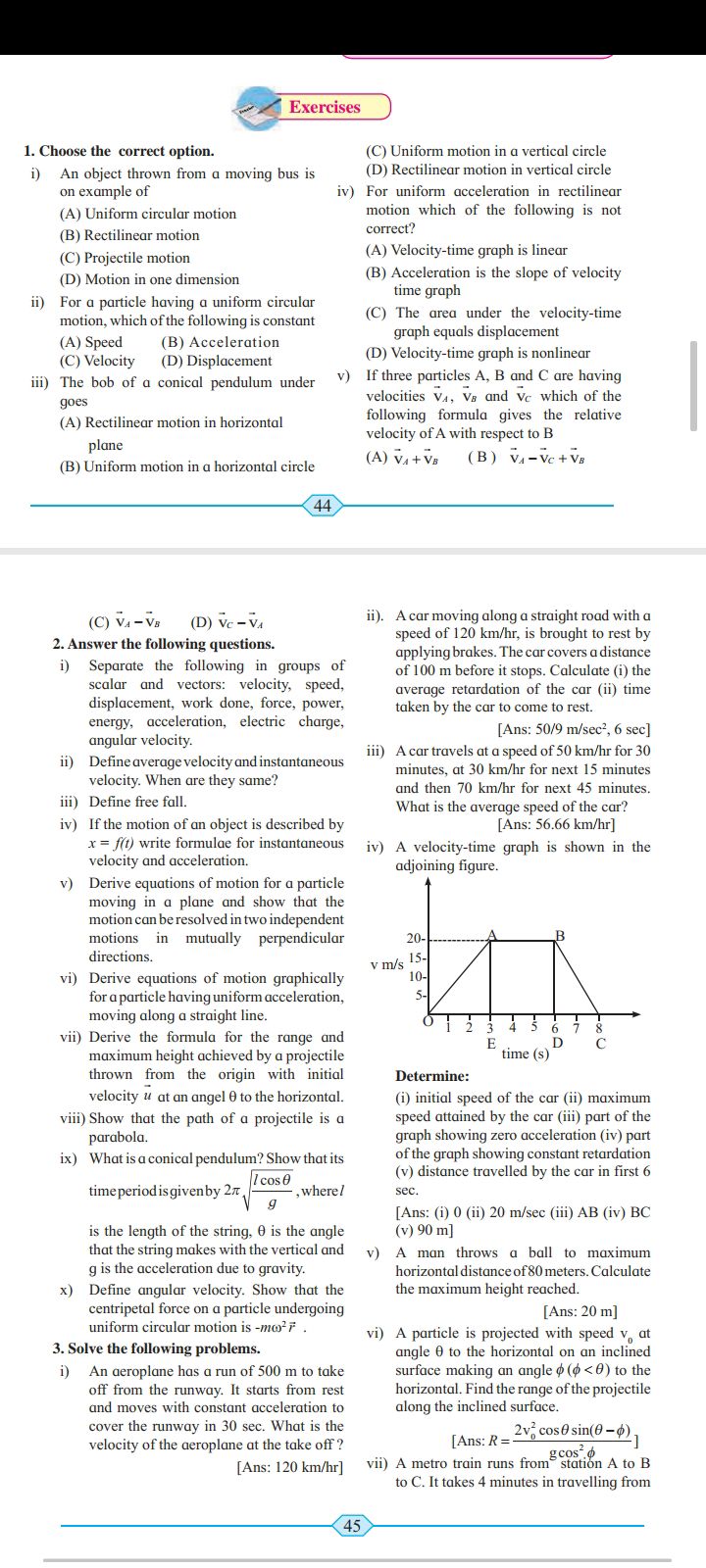
1. Choose the correct option., , i), , ii), , iii), , , , An object thrown from a moving bus, on example of, , (Ayu, (B) Rectilinear motion, , iv), , , , form circular motion, , , , (C) Projectile motion, , (D) Motion in one dimension, , For a particle having a uniform circular, motion, which of the following is constant, (A) Speed (B) Acceleration, , (C) Velocity (D) Displacement, , The bob of a conical pendulum under, goes, , (A) Rectilinear motion in horizontal, , 9), , plane, (B) Uniform motion in a horizontal circle, , Exercises, , (C) Uniform motion in a vertical circle, , (D) Rectilinear motion in vertical circle, , For uniform acceleration in rectilinear, , motion which of the following is not, , correct?, , (A) Velocity-time graph is linear, , (B) Acceleration is the slope of velocity, time graph, , (C) The area under the velocity-time, graph equals displacement, , (D) Velocity-time graph is nonlinear, , If three particles A, B and C are having, , velocities Vi, Ve and Ve which of the, , following formula gives the relative, , velocity of A with respect to B, , (A) VatVs (B) W=Ve+Ve, , , , 44, , (©) Va-Ve — (D) Ve=Va, , 2. Answer the following questions., , i) Separate the following in groups of, scalar and vectors: velocity, speed,, displacement, work done, force, power,, energy, acceleration, electric charge,, angular velocity., , ii) Defineaverage velocity and instantaneous, , velocity. When are they same?, , Define free fall., , If the motion of an object is described by, , x= f(d) write formulae for instantaneous, , velocity and acceleration,, , , , iii), iv), , , , v) Derive equations of motion for a particle, moving in a plane and show that the, motion can be resolved in two independent, motions in mutually _ perpendicular, directions., , , , vi) Derive equations of motion graphically, for a particle having uniform acceleration,, moving along a straight line, , Derive the formula for the range and, maximum height achieved by a projectile, thrown from the origin with initial, , vii), , velocity # at an angel @ to the horizontal, , viii) Show that the path of a projectile is a, parabola., , ix) Whats aconical pendulum? Show that its, , [Icosé, , g, , , , , , timeperiodisgivenby 2. | swhere!, is the length of the string, 0 is the angle, that the string makes with the vertical and, Gis the acceleration due to gravity, , x) Define angular velocity. Show that the, centripetal force on a particle undergoing, uniform circular motion is -moy, , , , 3. Solve the following problems., , i) An aeroplane has a run of 500 m to take, off from the runway. It starts from rest, and moves with constant acceleration to, cover the runway in 30 sec. What is the, velocity of the aeroplane at the take off ?, , [Ans: 120 km/hr], , , , ii), Acarmoving along a straight road with a, speed of 120 km/hr, is brought to rest by, applying brakes. The car covers adistance, of 100 m before it stops. Calculate (i) the, average retardation of the car (ii) time, taken by the car to come to rest., , [Ans: 50/9 m/sec?, 6 sec], Acar travels at a speed of 50 km/hr for 30, minutes, at 30 km/hr for next 15 minutes, and then 70 km/hr for next 45 minutes, What is the average speed of the car?, , [Ans: 56.66 km/hr], A velocity-time graph is, adjoining figure., , , , iii), , shown in the, , , , , iv), , , , 45678, , c, time (s), , Determine:, (initial speed of the car (ii) maximum, speed attained by the car (iii) part of the, graph showing zero acceleration (iv) part, of the graph showing constant retardation, (v) distance travelled by the car in first 6, sec., , [Ans: (i) 0 (ii) 20 m/sec (iii) AB (iv) BC, (v) 90 m], , v) A man throws a ball to maximum, , horizontal distance of 80 meters. Calculate, , the maximum height reached,, [Ans: 20 m], , A particle is projected with speed v, at, , angle 0 to the horizontal on an inclined, , surface making an angle $ ($<) to the, horizontal. Find the range of the projectile, along the inclined surface., , 2vicos0 sin(@-$), , vi), , [Ans: R, , A metro train runs from’, to C. It takes 4 minutes, , 1, gcos, ERhiibe A to B, travelling from, , vii), , , , , , 45