Assignment of IIPU Computer Science Boys(GS), Computer Science (41) Model Question paper - Study Material
Page 1 :
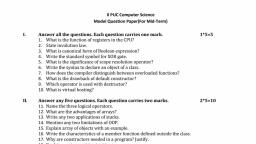
TIL., , Il PUC Computer Science, Model Question Paper(For Mid-Term), , Answer all the questions. Each question carries one mark. 1*5=5, What is the function of registers in the CPU?, , State involution law., , What is canonical form of Boolean expression?, , Write the standard symbol for XOR gate., , What is the significance of scope resolution operator?, , Write the syntax to declare an object of a class., , How does the compiler distinguish between overloaded functions?, What is the drawback of default constructor?, , . Which operator is used with destructor?, , 10. What is virtual hosting?, , SOS G0 GN Fe a pi pe, , Answer any five questions. Each question carries two marks. 2*5=10, 11. Name the three logical operators., , 12. What are the advantages of arrays?, , 13. Write any two applications of stacks., , 14. Mention any two limitations of OOP., , 15. Explain array of objects with an example., , 16. Write the characteristics of a member function defined outside the class., , 17. Why are constructors needed in a program? Justify., , 18. Explain any two resizing text tags., , Answer any five questions. Each question carries three marks. 3*5=15,, , 19. Explain different types of motherboard., , 20. Write the truth table of three inputs AND gate., , 21. Consider the array A of order 25 x 4 with base value 2000 and one word per, memory location. Find the memory address of A[12][3] in row-major order., , 22. Write an algorithm for POP operation., , 23. Mention the situations in which the inline function may not work., , 24. Write the features of parameterized constructors., , 25. Write the structure of HTML program., , 26. Write any three features of DHTML., , Answer any seven questions. Each question carries five marks. 5*7=35, , 27. Explain the different I/O ports and interfaces., , 28. State and prove absorption laws of Boolean algebra., , 29. Given the Boolean function F(W, X, Y, Z) = ¥{(0, 2, 3, 4, 7, 8, 11, 12). Reduce it by using Karnaugh, map., , 30. Explain NAND-to-NAND rules and NOR-to-NOR rules of logic network., , 31. Explain the different operations performed on linear data structure., , 32. Write an algorithm for deleting an element from the array., , 33. Define:, a. Object b. Class c. Data abstraction d. data encapsulation e. Polymorphism ., , 34. What are the advantages OOP over earlier programming methods?, , 35. Explain arrays as member of the class with suitable programming example., , 36. What is function overloading? Explain with a programming example., , 37. Explain copy constructor with an example.



 Learn better on this topic