Notes of 10 C His.Civ.Geo, Social Source Based - Study Material
Page 1 :
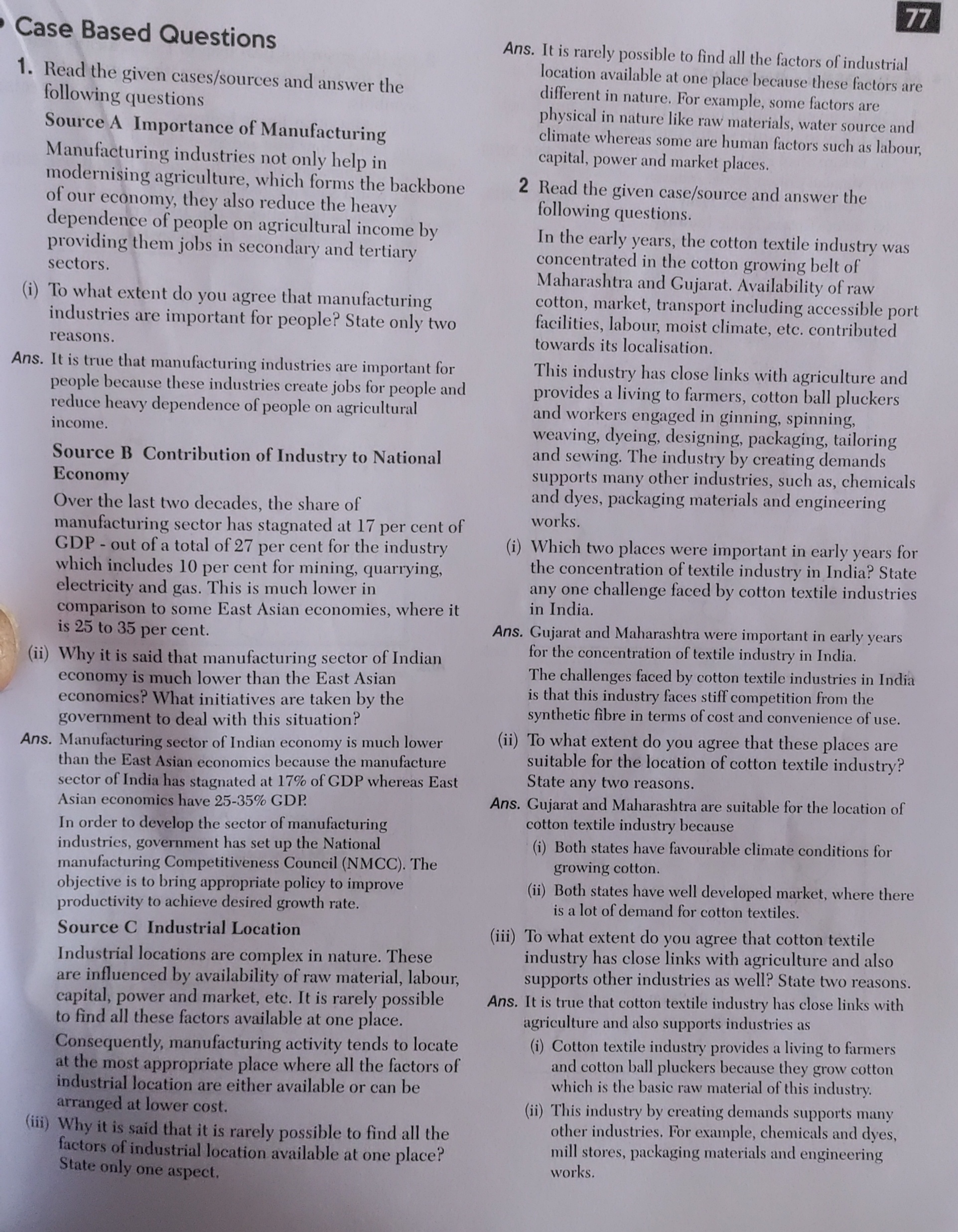
’ Case Based Questions, , 1. Read the given case, following questions, , Ans. It is rarely possible to find all the factors of industrial, location available at one place because these factors are, different in nature, For example, some factors are, physical in nature like 1, , climate whereas some, , s/sources and answer the, , raw materials, water source and, Source A Importance of Manuf;, , acturing are human factors such as labour,, Manufacturing industries not only help in capital, power and market places., modernising agriculture, which forms the backbone, of our economy, they also reduce the heavy, dependence of people on agricultural income by, providing them jobs in secondary and terti :, sectors., , 2 Read the given case/source and answer the, following questions., , In the early years, the cotton textile industry was, concentrated in the cotton growing belt of, Maharashtra and Gujarat. Availability of raw, cotton, market, transport including accessible port, facilities, labour, moist climate, ete. contributed, towards its localisation., , ary, , (i) To what extent do you agree that manufacturing, industries are important for people? State only two, reasons., , Ans. It is true that manufacturing industries are important for, people because these industries create jobs for people and, reduce heavy dependence of people on agricultural, income., , This industry has close links with agriculture and, provides a living to farmers, cotton ball pluckers, and workers engaged in ginning, spinning,, weaving, dyeing, designing, packaging, tailoring, and sewing. The industry by creating demands, supports many other industries, such as, chemicals, and dyes, packaging materials and engineering, , Source B Contribution of Industry to National, Economy, , Over the last two decades, the share of a., manufacturing sector has stagnated at 17 per cent of SS, GDP - out of a total of 27 per cent for the industry (i) Which two places were important in early years for, which includes 10 per cent for mining, quarrying, the concentration of textile industry in India? State, electricity and gas. This is much lower in any one challenge faced by cotton textile industries, comparison to some East Asian economies, where it in India., , is 25 to 35 per cent. Ans. Gujarat and Maharashtra were important in early years, , ‘ on ; D i ile industry in India., (ii) Why itis said that manufacturing sector of Indian for the concentration of textile industry in India, , , , economy is much lower than the East Asian, at initiatives are taken by the, government to deal with this situation?, , , , Ans. Manufacturing sector of Indian economy is much lower, , than the East Asian economics because the manufacture, sector of India has stagnated at 17% of GDP whereas East, Asian economies have 25-35% GDP., , In order to develop the sector of manufacturing, industries, government has set up the National, manufacturing Competitiveness Council (NMCC). The, objective is to bring appropriate policy to improve, productivity to achieve desired growth rate., , Source C Industrial Location, , Industrial locations are complex in nature. These, , are influenced by ayailability of raw material, labour,, , capital, power and market, ete. It is rarely possible, , to find all these factors available at one place., Consequently, manufacturing activity tends to locate, nost appropriate place where all the factors of, mn are either available or can be, , , , , ‘ly possible to find all the, available at one place?, , The challenges faced by cotton textile industries in India, is that this industry faces stiff competition from the, synthetic fibre in terms of cost and convenience of use., , (ii) To what extent do you agree that these places are, , suitable for the location of cotton textile industry?, State any two reasons., , Ans. Gujarat and Maharashtra are suitable for the location of, , cotton textile industry because, (i) Both states have favourable climate conditions for, growing cotton., (ii) Both states have well developed market, where there, is a lot of demand for cotton textiles., , (iii) To what extent do you agree that cotton textile, , industry has close links with agriculture and also, supports other industries as well? State two reasons., , Ans. It is true that cotton textile industry has close links with, , agriculture and also supports industries as, (i) Cotton textile industry provides a living to farmers, and cotton ball pluckers because they grow cotton, which is the basic raw material of this industry., , (ii) This industry by creating demands supports many, other industries, For example, chemicals and dyes,, mill stores, packaging materials and engineering, works.