Notes of Bsc Nursing 3rd Year, Research Pre Experimental - Study Material

Page 1 :
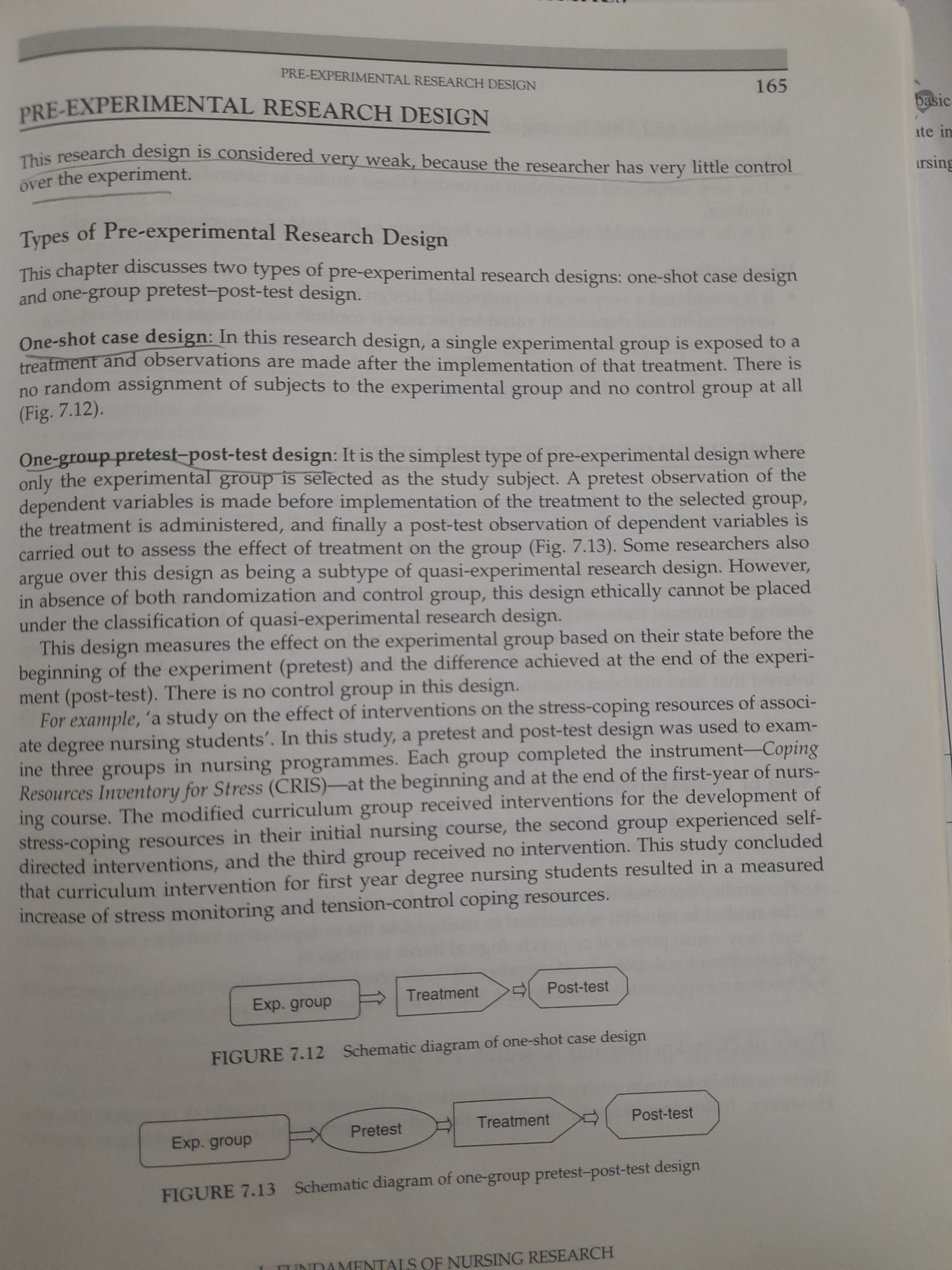
“165, pRE-EXPERIMENTAL RESEARCH DESIGN, a :, Demeepenmen stk. because the researche Se Game. tacts very_weak, because the researcher has very little control, gon nana, , Types of Pre-experimental Research Design, , This chapter discusses two types of pre-experimental research designs: one-shot case design, and one-group pretest—post-test design., , Qne-shot case design: In this research design, a single experimental group is exposed to a, trea observations are made after the implementation of that treatment. There is, , no random assignment of subjects to the experimental group and no control group at all, (Fig. 7.12)., , eer pony ore It is the simplest type of pre-experimental design where, only the experimental gro, , is selected as the study subject. A pretest observation of the, dependent variables is made before implementation of the treatment to the selected group,, the treatment is administered, and finally a post-test observation of dependent variables is, carried out to assess the effect of treatment on the group (Fig. 7.13). Some researchers also, argue over this design as being a subtype of quasi-experimental research design. However,, in absence of both randomization and control group, this design ethically cannot be placed, under the classification of quasi-experimental research design., , This design measures the effect on the experimental group based on their state before the, beginning of the experiment (pretest) and the difference achieved at the end of the experifd en (post-test). There is no control group in this design., _ For example, ‘a study on the effect of interventions on the stress-coping resources of associate degree nursing students’. In this study, a pretest and post-test design was used to exam, groups in nursing programmes. Each group completed the instrument—Coping, ces Inventory for Stress (CRIS)—at the beginning and at the end of the first-year of nurs, *h odified curriculum group received interventions for the development of, a ewe in their initial nursing course, the second group experienced self“ge es the third group received no intervention. This study concluded, ost ing students resulted in a measured, tion for first year degree nursing S$ e, ing and tension-control coping resources.