Notes of Class 12 (Arts+Sci), English By- LA Preposition - Study Material
Page 1 :
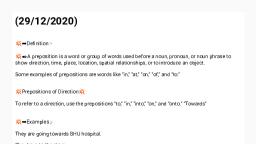
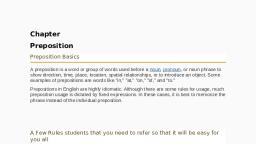
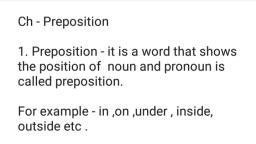
GRAMMAR AND MECHANICS, Using Prepositions, A preposition may be defined as a connecting word showing the relationship between a noun or a, noun substitute to another word or combination of words in a sentence, for example, “The young, man in the first row is an excellent student.” In this sentence, the preposition “in” shows the, relationship between a noun (“the young man”) and a combination of words that illustrate, location (“the first row”)., The most commonly used prepositions include the following: in, with, to, from, at, of, by, for,, and on., Prepositions cause problems for several reasons: sometimes they can be used interchangeably, (“He sat on the chair.”/“He sat in the chair.”); prepositions are often combined with verbs to, create phrasal verbs (to look after someone/to look down on someone); and because a single, preposition can be used to express several different ideas (“He is tall for his age.”/“I swam for, an hour.”)., The most efficient method of study is to familiarize yourself with prepositions and prepositional, phrases through practice and memorization. This is particularly helpful for bilingual students,, who often seem to find preposition usage one of the most difficult parts of the English language., , USING PREPOSITIONS, Prepositions are used to express a number of relationships, including time, location (place or, direction), means or agent, manner, state or condition, quantity or measure, and purpose or, reason., , Time, , at:, , about noon (approximately), after the game, after lunch, after three, at five o’clock, , by:, for:, , at last (finally), by midnight (no later than), for an hour (duration), , about:, after:, , in:, , in the morning, in the fall, , in:, , on:, , past:, to:, , in April, in 1987, in six months (at the end of), in time (early enough), on Tuesday (day of the, week), on May 8 (date), on time (punctual), a quarter past three (15, minutes after), a quarter to three (15 minutes, before), , Dr. Murray and Anna C. Rockowitz Writing Center, Hunter College, City University of New York
Page 2 :
Place or Direction, around:, at:, , down:, from:, in:, , She walked around the car., They are at home., We were at the restaurant., He smiled at her., She looked at the menu., They lived down the hall., The cat walked down the stairs., We immigrated from Peru in 1991., The restaurant is one mile from here., He lives in a trailer., We waited in the bus., , inside:, of:, , Put it inside the house., We moved south of Montreal., , on:, , We sat on the ocean pier., She left on the train., They drove through the tunnel., , through:, to:, up:, with:, , He went to Prague., Give it to me., He walked up the stairs., He went with me., , Means or Agent, by:, , He was hit by a ball., She came by train., It came by special delivery., He got there by swimming., , from:, , His success results from, careful planning., , on:, with:, , They live on bread and water., He chased the mongoose with, a stick., , By doing it yourself, you save time., He left in confusion., The room was in turmoil., You can do it in a day., , like:, on:, with:, , He looks like a hero., I swear it on my word of honor., He ate it with a fork., , for:, in:, on:, , I mistook you for someone else., He is in a state of confusion., He is on duty. (scheduled to work), , for:, , We drove for twenty miles., We bought it for ten cents., , Manner, by:, in:, , State or Condition, as:, at:, by:, , I see her as a good person., My friend is at work., She is at home., They are by themselves. (alone), , Quantity or Measure, by:, , We bought them by the kilo., , Purpose or Reason, for:, , He bought it for an emergency, She went to the city for sightseeing., He loved her for her thoughtfulness., , Dr. Murray and Anna C. Rockowitz Writing Center, Hunter College, City University of New York
Page 3 :
USING PREPOSITIONAL PHRASES, A prepositional phrase begins with a preposition and includes the object of the preposition (a, noun, pronoun, or other word group) and its modifiers (in the park, on the table, under the desk,, after the storm, with the group)., The president of the company reflected on the growth of domestic and global assets and, the potential for continued success in the upcoming fiscal year., In this sentence, the prepositional phrase “of the company” begins with the preposition “of” and, includes the object of the preposition “company” and the modifier “the”; other prepositional, phrases are “on the growth,” “of domestic and global assets,” “for continued success,” and “in, the upcoming fiscal year.” Prepositions that indicate time and location and usually appear as part, of a prepositional phrase are often the most problematic to use correctly, especially the, prepositions on, in, at, and by, as illustrated below:, , Prepositional Phrases that Show Time, on, in, at, by, , on a specific day (on Wednesday) or date (on June 20), in a part of a particular day (in the evening), a specific month (in June), a, specific year (in 1965), or a specific period of time (in two hours), at a particular time (at 6:30, at midnight), by a particular time (by the end of next week), , Prepositional Phrases that Show Location, on, in, at, by, , on a surface (on the desk), a specific street (on Seventh Avenue), or an, electronic medium (on the Internet), in a particular space (in the apartment), a geographic location (in New, York City), or a print medium (in the newspaper), at a particular place (at the store) or location (at the center), by a familiar place (by the house), , USING ADJECTIVE AND VERB + PREPOSITION COMBINATIONS, Many adjectives and verbs can be combined with prepositions to appear together in idiomatic, phrases., , Adjective + Preposition Combination, He was angry with his brother-in-law. (the adjective “angry” is used with the, preposition “with”), , Verb + Preposition Combination, He forgot about the appointment. (the verb “forgot” is used with the preposition, “about”), Dr. Murray and Anna C. Rockowitz Writing Center, Hunter College, City University of New York
Page 4 :
Common Adjective + Preposition Combinations, according to, accustomed to, addicted to, angry about (something), angry at (someone), angry with (someone), ashamed of, aware of, based on, capable of, committed to, composed of, concerned about / with, connected to, content with, dedicated to, , dependent on / upon, different from / than, disappointed in, due to, engaged to, excited about, familiar with, followed by, fond of, full of, guilty of, have respect for, in accordance with, independent of / from, in regard to, interested in, , involved in / with, known as / for, limited to, made of / from, married to, opposed to, preferable to, proud of, related to, responsible for, resulting from, satisfied with, scared of, similar to, tired of, worried about, , Sample Verb + Preposition Combinations, account for, agree on (something), agree with (someone), apologize to, apply for / to, approve of, argue with (someone), arrive at / in, ask for, believe in, belong to, blame (someone) for (something), blame (something) on (someone), borrow from, call on / upon, care about / for, compare to / with, compliment (someone) on, come from, concentrate on, consent to, , consist of, convince (someone) of, (something), count on, decide on / upon, depend on / upon, disagree with, dream about / of, feel like, forget about, get rid of, happen to, hear about / from / of, hope for, insist on / upon, invite (someone) to, laugh at, listen for / to, look at, look for, look forward to, , object to, participate in, plan on provide for, provide with, recover from, remind (someone) of rely on, reply to, respond to, result in, search for, see about, speak to / with, stare at, substitute for, succeed at / in, talk about / of, talk of, think about, think of, wait for / on, , Dr. Murray and Anna C. Rockowitz Writing Center, Hunter College, City University of New York



 Learn better on this topic